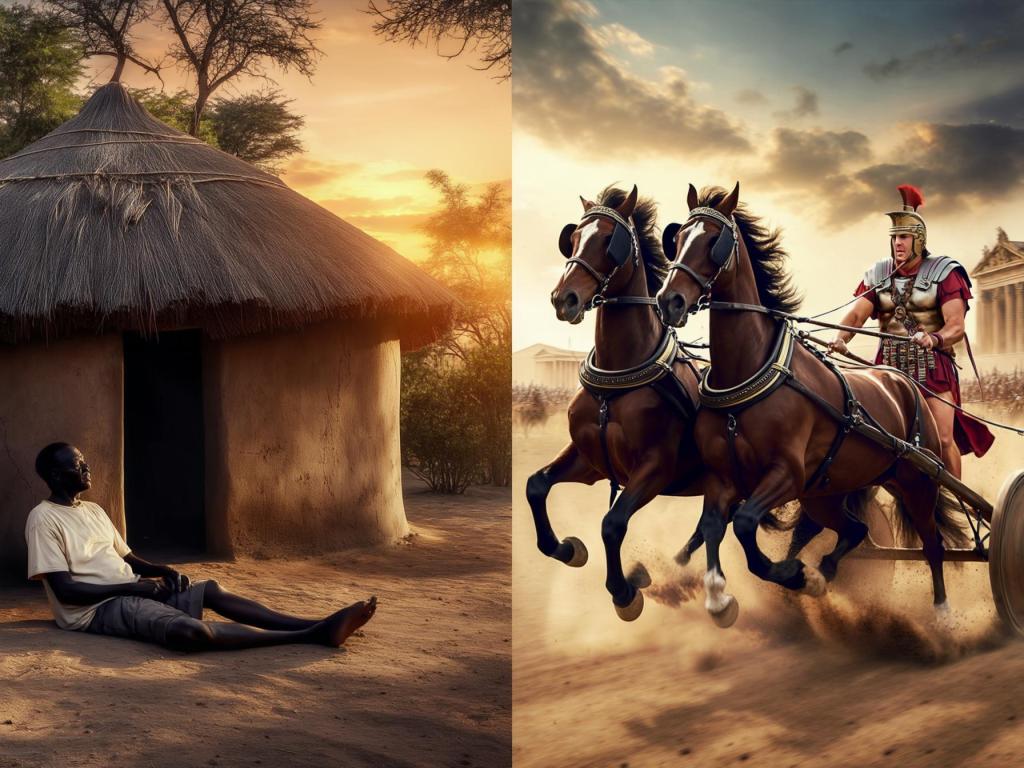
The reluctant classroom: where the pain and progress of colonialism forged civilization.
Colonialism is a big word, isn’t it? Wikipedia’s definition makes you think of kings sending ships full of lecherous citizens to occupy and plunder faraway lands. Sometimes it does feel like the West bragging, “We did it all!” Other times I remember the stories of the mentors of my youth—Muhle the Matabele and Pioneer Charlie—who drew pictures of tough teachers pushing folks to learn hard lessons.
Children today will tell you, “Oh, colonialism’s when Europeans took over Africa, grabbed everything, and left it a mess. The black people were damaged.” Their big empty heads have been filled with the politically convenient. Like most misinformation, it’s mostly right, but it is where it is wrong that turns the truth on its head.
To understand colonialism properly, we need to see it as just one chapter in humanity’s long journey. Our story begins not with ships and flags but with our earliest ancestors learning to survive together.
Way back—long before houses or cities—our fiercely determined but clueless, half-ape ancestors learned survival’s first lessons in the East African jungles. Being the lowest predators, they mastered stillness, silence, and teamwork. These lessons created the beginnings of the economy—not money, but networks of meaningful relationships where people consciously worked together. Our new knowledge allowed us to cut a few meters further down that road never before travelled—an animal wanting to be human deliberately reshaping billions of years of survival behaviors!
This cooperation between group members and between the body and brains of each individual created something new: humanity—the drive to make life better for everyone groupwide each day. But this generosity faced its first test when strangers appeared—they definitely were not “Us.” We fought them, sometimes to extinction. Then came a pivotal realization: why kill potential helpers when our numbers were so few? Slavery began—a giant step in the recognition that those we’d considered “Them” and therefore dangerous could become “Us.”
As we didn’t have the logistical brain to manage, as we grew, extended families split. As groups wandered west from East Africa, following the sun until they reached the Atlantic, they found fertile lands where they could settle. Over thousands of years, communities took root, with tribes expanding, competing, and sometimes conquering one another. Empires would rise and fall across the continent, each dominating physically for a time before being replaced—a pattern repeated throughout Africa as it was worldwide.
Meanwhile, the graduates of the “Great University of Eurasia”—the becoming non-black humans who had migrated northward—were developing a revolutionary habit that wasn’t to replace slavery but to add a new line: looking at neighbours’ land and thinking, “I could do better.”
Back then it wasn’t called colonialism—it was elders standing on hills, saying, “We’ll take that land, show them how to work it properly, and take a cut.” It was conquest with a twist—a rough kind of teaching, sure, but a massive advance on sending an army in and, when they’re done destroying, hauling everything of value home. This colonialism business demanded high-level strategic planning.
They’d settle in, share techniques, and rather than take something back, they’d send something back. This risky business of moving in permanently and reshaping others’ lives worked. Skills spread, and with them came the Eurasian gift of “what if?” thinking—imagination’s flame brightened the world, pushing human ingenuity and empathy further down the road never before travelled.
Things moved fast. China and India too? My golly, yes, but that’s a book—too much for tonight!
Around 2334 BCE, Akkad tied three places into one—figuring out how to run a big show. Babylon, in 1754 BCE, gave us Hammurabi’s Code—rules written down so everyone knew them. Hittites brought iron tools and chariots—great for fighting, better for working, productivity soared. Assyria built a library in Nineveh, stacking up an open-to-the-public repository of stories and know-how. Neo-Babylon pushed architecture, made the Hanging Gardens—pretty enough to be a Wonder. Persia’s Cyrus the Great, in 539 BCE, wrote a note saying, “Be nice to the folks we take over.” Alexander the Great spread Greek ideas—art, science, and thinking—all the way to India. Maurya’s Ashoka turned to peace, spreading it across India.
Then Rome showed up, changing everything. They formed the known western world into one great multinational school, oh err, sorry, empire of colonies. Anyway, while they dealt as severely with detractors as history had, the Romans catered for client children through to post-PhD study.
Under one of the stones they looked under, they found Britain—wild, terribly aggressive, scattered folks living simple. For reasons never made clear, the Romans didn’t curse, mutter, “No, too much trouble,” and go back to France. But neither did Rome mess around. They gave them the name Britons of Britain, seeded cities, built roads, cities, sewers, temples, reading and counting, and, oh yes, “what if” thinking. By 410 CE, Rome left, but Britain couldn’t go to a half-animal existence. They’d learned too much—more roads connected more towns, reading and counting stuck.
Without Rome’s 450-year push, would Britain have ruled the world later? With Europe sophisticating even faster, it’s more likely they’d have slid into King Shaka’s Zulu ways, strong but indifferent and decidedly ignorant. Colonialism handed Britons a flaming torch; they kept it burning bright.
Meanwhile, across Africa, empires rose and fell like waves on a shore. In Central-Southern Africa, the Rozwi Empire established a collective of Shona, and on the eastern coast, various kingdoms emerged. Trade happened primarily with Muslim merchants from the Arabian Peninsula, mainly for ivory and slaves. Development remained localized and inward-looking, with little of the cross-pollination of ideas that was transforming Eurasia.
In Rip Van Winkle, American literature illustrates sub-Saharan Africa. Rip fell asleep while the world was in a state of great change. When he woke, everything had transformed—the Revolution had happened, his friends had moved on, and the world was unrecognizable. For thousands of years Africa slept warm beside the fire. It woke to find a world dramatically reshaped.
In the UK there was no time to sleep; the lessons kept coming. The Vikings occupied parts for nearly 200 years bringing shipbuilding ideas, navigation, metalworking, a better plough, and added (berserk and club) to the embryonic English language! They were pushed out in 1066. The Normans—French folks trained by Rome’s example—brought laws and fancy talk. By Queen Elizabeth I’s time, 1558-1603, England was ready to shine. Shakespeare wrote plays that made you dream; Drake and Raleigh sailed and fought; the East India Company started an empire in 1599. When they begged the Dutch for ships and got the answer, “Make your own!” they did—better! Money got tight, wars got big, and in 1694, the Bank of England was born. Eurasia was buzzing—Ottomans, French, Spanish, Moors, and Jews in Germany, all trading ideas. By 1500 CE, they turned their eyes to Africa.
That’s where we’ll pick up next time—colonization wakes Africa.




 Douglas Schorr
Leave a comment