Inequality kills poverty. The proof is Sub-Saharan Africa.
Poverty has a cure: celebrate the “unequal” person. The achiever, the innovator, the one who sees and thinks further, works smarter, and crucially, pulls others up.
Without these unequals, societies regress. With them, they flourish.
Yet across Sub-Saharan Africa, a devastating cultural legacy persists—the systematic suppression of the unequal. That the developed world has, by comparison, an abundance of unequals gives foundation to the Woke’s fixation on “cancel culture.” They’re incapable of seeing that inequality kills poverty.
This isn’t theory; tied with three other Sub-Saharan countries, Malawi is in a tussle to become the world’s most equal society. Of the top 30, expect 27 or 28 to be black African. 70% of Malawians survive on less than US$2 daily. Instead of celebrating this woke dream of equality, they scream “Colonialism did this!” The irony? When I considered working there when Malawi got independence in 1964, it was poor but not desperate. The unequals who taught and trained, who wanted to go beyond using dugouts to fish Lake Malawi, left.
From plants to lions, hierarchies evolved as life’s solution to chaos. In humans, imagination sparked an evolutionary revolution. Eurasian hierarchies grew increasingly complex, supporting multidimensional economies—captured in children’s rhymes about butchers, bakers, and candlestick makers that illustrated their world’s diverse layers of inequality. African structures, conversely, remained flat, focused on tribal survival’s basics: produce and parent, provide and protect.
Eurasian hierarchies were not simple lines of authority but living economic maps—the personalities, number of boxes, and their positions weren’t static but responded to economic demands. Not today’s misconceived economy, but the original that asked everyone to strive for better performance daily for group benefit. Each new level created opportunities and specialties—a Eurasian doctor could become a scientist, community leader, or business pioneer, funding others. His African counterpart remained merely the respected witchdoctor, trapped in a single role by structures that feared excellence. Modern economies are these accumulated layers of specialized knowledge and skill, each building on those below or spinning off from those above. When unequals who create and climb these layers are suppressed, the very structure that allows everyone to rise collapses. This is why Sub-Saharan Africa’s enforced equality became a deadly trap.
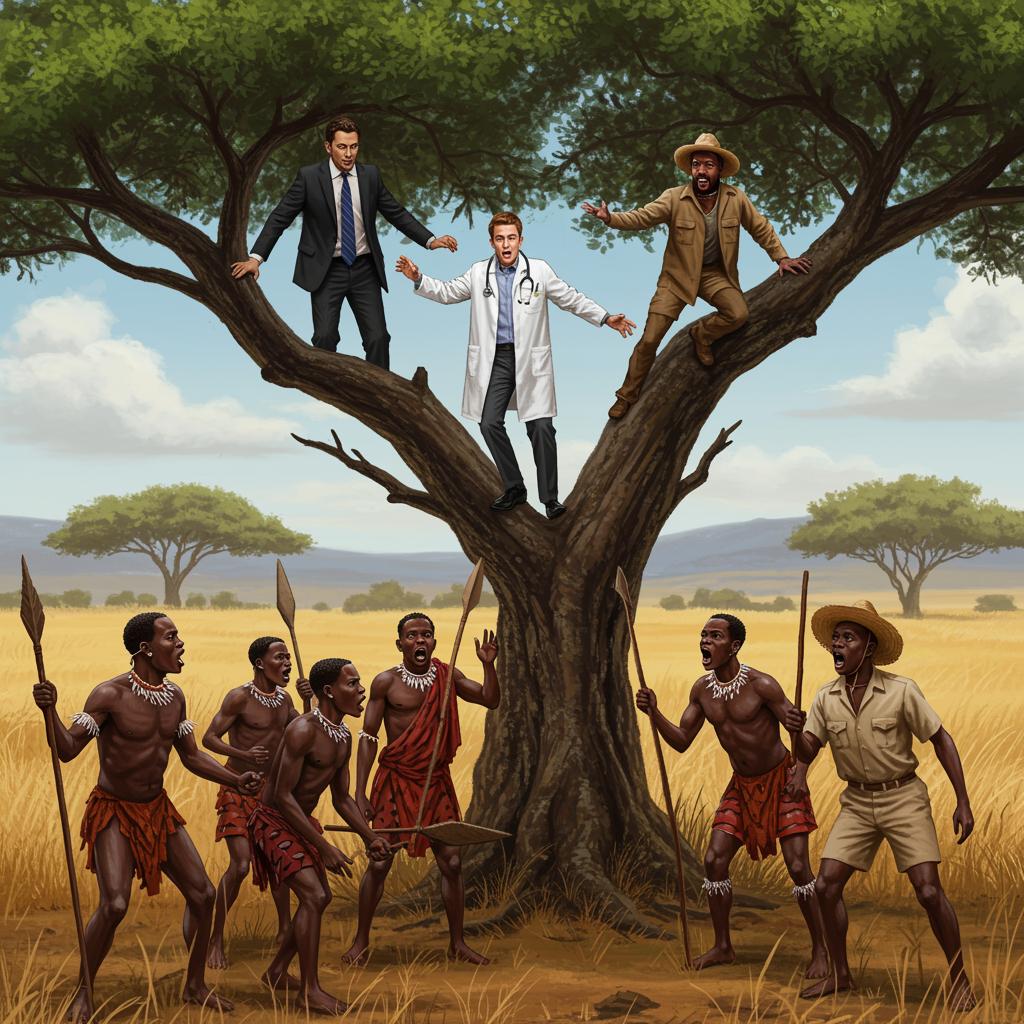
Two Leader Dads. The Eurasian rises, congratulates all for their day’s efforts, and singles out the exceptional. Everyone secretly hopes to make tomorrow’s list of achievers. This natural competition led to the birth of the ‘unequal’ human and ever-higher pyramids of achievement. But under the Southern Cross, Leader Dad faces a cruel choice. Those who show too much promise, who stand out, could become dangerous to an almost flat tribal structure that has little room for career ladders or advancement. If the achiever is too far from the inner circle or simply too naïve to know when to slow down, they excite the slave traders or feature in execution rituals. Stripped of enough ‘unequals’ Africa’s structures remained tribal survival tools.
The woke are right about one thing—it starts at the top. But while their leaders call for “rampage, protest,” and their followers obey, they miss how natural hierarchies actually work. These aren’t rigid command structures but dynamic, living entities. Nature itself shows us how: just as it culls the laggards like a lion picks off the limping wildebeest, it rewards the achievers who adapt and excel. Most are average and safe.
The achievers, the outperformers, constituted the unequals who in Eurasia made hierarchies’ economies living maps. The more high achievers there are, the more successful the average becomes in their endeavours simply because the number of positive relationships in the community grows faster. As much as it responds to goals flowing top-down, the response is improvements pushing from the bottom, the middle, and sideways—wherever those unequals play. Slowly, the dream of continually adding value to the economy by expanding diverse yet interlocking activities became reality. Life was no longer about mere survival but about each having a life worth living!
With all the unequals moving up (until their personal top is reached) in an expanding environment, for Mr. and Mrs. Ordinary, who is the top and where does the top start? 100 equal people can physically lift a boat, but when its put down, that’s it. A couple of unequals can teach and train that 100 to do substantially and sustainably more. The goal is for everyone to wake up eager to contribute something real while getting a fair reward.
Leader Dad plans, and his lieutenants organise the big kill. The whole provisioning team is involved—trackers, hunters, skinners, butchers, porters—and at home, a whole new sequence begins. That’s the way a modern economy works, except with bigger words, more moving parts, and worker’s houses suburbs apart. Each, at their own level, creates their own wealth.
Pre-colonial Zulu society illustrates the contrast perfectly: life belonged to the king in trust for the tribe, with one job per gender. Males became warriors, and females managed homes and children. No one imagined better because 99% equality meant no one could climb higher. The only advancement came through successful raids. For the reason that the average equal African person is imbued with millions of years of single-level loyalty and sources of security, shelter, food, succour, there has been no easy transition into modernity for the majority. New concepts of inequality and unequal have to be built.
During the Great Depression, along with other job seekers on the Rand (SA’s major industrial zone), my father was party to a protest whisper: destroy the Oppenheimer empire and distribute their wealth. Within the week, reality hit—Oppenheimer wealth wasn’t hidden in a mattress. It sustained thousands of businesses, all run by unequal people with unequal helpers, managing, directing, training, and promoting the average, hoping each in a little way would become unequal. Human capital and individual wealth grow through full-time jobs under competent bosses offering long-term careers to become unequal in that niche.
Both CEOs and cleaners matter. But while most adults can clean, competent CEOs are rare rhinos. The right leader ensures the hierarchy lives like a master gardener tends different plants. Everyone becomes a rose in their own patch, and everything grows better with proper care.
The solution to African poverty is the deliberate cultivation of inequality. Not the artificial inequality of corrupt politicians and crony capitalism, but the natural inequality that emerges when people are free to excel, to build, to teach, and to lift others up with them. Instead, the black elite’s approach to overcoming what they perceive as apartheid’s shortfalls was to lower pass marks and introduce quotas. That’s painting stripes on a mule and calling it a zebra. It won’t transform technicians into surgeons or cabin crew into pilots.
Today, only SA’s foreign affairs department maintains a high profile, eloquently criticising others while SA leads in corruption, violent crime, joblessness, unrest, and soaring ill-health—primary indicators of enforced equality. This tragic decline shows what happens when a society rejects natural inequality in favour of enforced mediocrity. Real community—true capitalism—thrives on diversity, different skills at many levels, all pulling together toward shared goals, with the best performers earning the best rewards. This isn’t oppression—it’s the only proven path to lifting everyone higher.
Inequality kills poverty every time. Bury it, and we become the limping wildebeest while history watches, laughing.



Leave a Reply