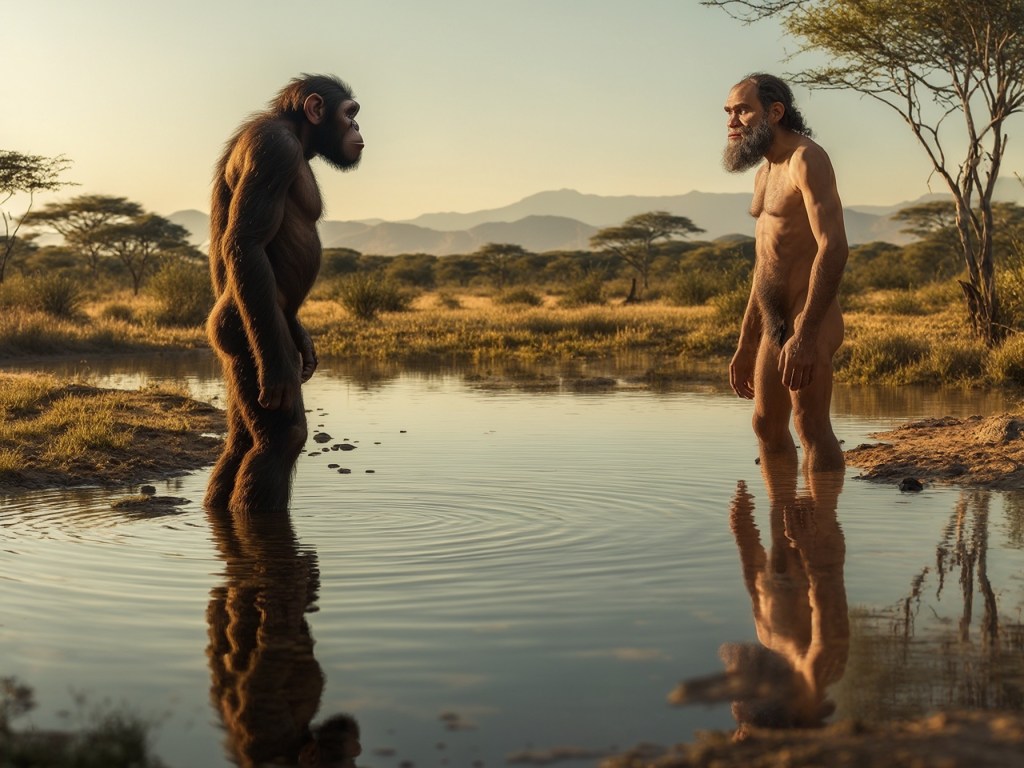
Six million years ago, our ancestors made the craziest gamble in evolutionary history—they left the trees for the ground. What followed was the birth of humanity.
Picture being there: the climate was changing, the rich forests shrinking. While most creatures simply followed the retreating jungle south, a few groups of forest apes… for reasons unknown… did the unthinkable. They stepped down. Above, the familiar safety of the trees. Ahead, the unknown ground that no ape had chosen to call home. This wasn’t just another day in evolution—this was the moment when our ancestors made the impossible choice.
With bodies built for branches, not barefoot walking, they chose the most dangerous place possible. Every other animal was better equipped: they had claws, fierce teeth, impressive strength. We had none of these—just a brain barely smarter than a chimp’s. Surviving this decision required something never seen before: rapid, enforced adaptation. While other animals had millions of years to perfect their survival strategies, we, this new animal we wanted to be, had to innovate daily. Like a child thrown into the deep end of a pool, our ancestors had to learn to swim in evolution’s deep end—or perish.
Just as morning mist descends from mountains to nourish valleys below, something extraordinary filtered into our struggling ancestors. The Trinity—Father Complicity, and Mothers Nature and Evolution—recognized this valiant experiment. Each trauma, each challenge, each desperate innovation began the building of something new: we weren’t just surviving; we were becoming, and it was taking us upwards. Each challenge was as if being thrown in that deep swimming pool, and we had to, simply had to, get to the other side. A mind capable of conscious, reasoned decisions was growing.
The transformation was gradual but profound. Watch our ancestors at the tide pools: first hiding (learned from terror), then watching (born from hiding), then thinking (sparked by watching), then planning (emergent thinking). Something extraordinary was happening—not just the growth of a brain, but the birth of a mind. While other animals developed larger brains, we alone developed a new dimension of consciousness. Our skulls, with their uniquely flexible joints, gave our expanding brains room to grow. As survival pressures demanded we learn from our mistakes (because a second mistake often meant death), these expanding brains developed something extraordinary: the thinking machine we call the mind. Our improved diet supported physical brain growth, but the real magic was in the increasing neural connectivity that enabled the “what if” ability.
This new mental capability wasn’t just about size – it was about connections. While our animal brain handled the survival basics of the 4 Ps, our emerging mind, through increasingly complex neural networks, began asking “what if?”
Consider this scene from our past: A family squats beside a rotting antelope carcass, contemplating breakfast. A youngster suggests smashing the leg bone for marrow, like hyenas do. The father dismisses it – tried before. But a larger cousin persists, “Did you try with a rock this big?” Crash, snap, scoop – and suddenly, a new source of nutrition emerges. One small improvement, multiplied across countless similar moments of innovation, slowly enhanced our survival chances.
Such revelations – elementary by today’s standards – were groundbreaking for beings whose adult intelligence matched that of a modern child. Progress was explosive by evolutionary standards, yet agonizingly slow by human measures. Each tiny advance took generations to spread and improve. The 4 Ps Handbook remained our only consistent guide through these millions of years of trial, error, and gradual improvement.
Each challenge solved strengthened these connections, creating new pathways for reasoning and imagination. The Trinity seemed to nurture this development, as each problem tackled led to more sophisticated neural networks, enabling us to handle ever more complex challenges. Even as this was happening within, on the ground, in our daily lives, something remarkable happened. We opened a new path to travel, one no other creature has been able to copy.
In time it widened to a road, and later still a highway called the “economy.” Not about trading or simple exchanges, but about ensuring community survival in an extremely hostile environment. Economy meant making sure everyone was safer, had access to food and water, had places to rest, and ensured the continuation of the group through successful breeding. Each person’s contribution to these fundamental needs was essential. Improving one’s contribution meant the whole group’s chances of survival improved.
The birth of the real economy is in sharp contrast to the degrading GDP measure of today: it was the continuous effort to improve individual performance through cooperation, building ever-stronger relationships that benefited everyone. Economy wasn’t just about survival—it was the engine that drove human development. Each individual’s commitment to excellence, to being better today than yesterday, guaranteed a greater input, raising the entire group’s capabilities.
Here’s the crucial understanding: humanity isn’t possible without economy. Just as a body needs a beating heart, human communities need this constant flow of individual improvement and optimal mutual support.
Our ancestors discovered that life works best when we commit to “striving to improve individual performance agreeably, networking with others with the aim of constantly and consistently growing mutually beneficial relationships within the community for the benefit of all at all times.” This wasn’t charity or simple cooperation—it was the fundamental operating economic system of human success. Everyone mattered because everyone contributed to this upward spiral of improvement. Before language, before cities, before air conditioning, we had this essential truth: individual excellence pursued through mutual support creates communities that thrive.
But thriving meant competing for resources that every other group also needed. Immediately recognizing “them” became our greatest defensive tool.
The dozen or so separate groups of learner humans scattered about the equator were each developing their own versions of economy and humanity. In our isolated valleys and territories, we were doing so well we began to compete with the lion for the title “King of the Jungle.” What could possibly go wrong?
The answer came when groups first encountered each other. The shock was profound. These weren’t just strangers—they were competitors for resources. But most unsettling was their familiarity. Because true economy could only emerge from “striving to improve individual performance agreeably, networking with others for mutual benefit,” each group had inevitably developed systems that were offensively similar.
“It’s outrageous—they’ve copied us, and now they want OUR stuff!” became the primitive reaction, made all the more bitter by this mirror-image recognition.
Despite sharing the same evolutionary journey and the same 4 Ps foundation, each group had developed its own identity—different enough to be threatening, yet similar enough to be infuriating. The encounter with these “others” triggered something primitive in our newly evolved brains—fear, territoriality, and the brutal logic of competition. The disease “Us and Them” was set to go viral.



 Douglas Schorr
Leave a reply to American Slavery Reparations: Who Should Pay Whom? – Douglas Schorr Cancel reply