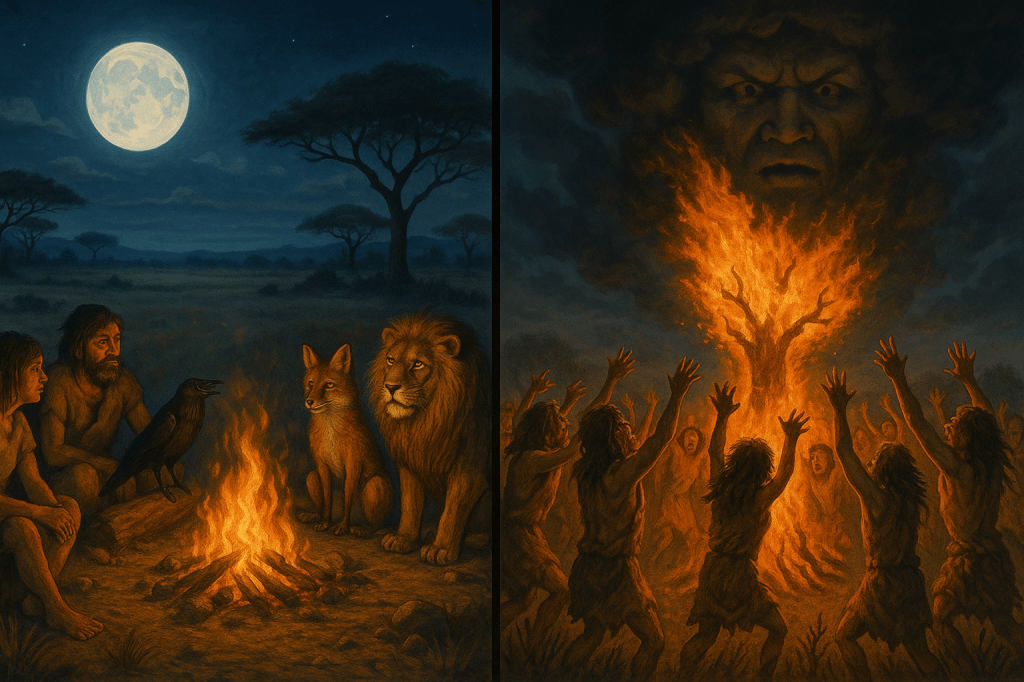
How mime before myth made the first theology …
Mm. Are Gods Necessary?
We gestured toward the moon, the mountain,
mused of teacher—great father.
This was our first theology:
movement, memory of the mentor gone.
In his image, gods we made.
They were not omnipotent. They were necessary—
to explain who carried daily the sun across the sky,
but often forgot to bring on the moon before.
To explain the thunder, the death, the drought.
To bind the group. To soothe the child.
To make the mime mean more.
Fasting wasn’t sacred.
It hung on the hunters’ spears.
Settled, it was seasonal.
Crop stores ran low. Herds were spared.
We learned to wait, to share, to endure.
And when the rains returned, we remembered—
not great-grandfather, but a new figure in the sky.
Eden was a metaphor—not a place.
A dream of cooperative, community hoop-jumping competition.
A hope that we could all get along.
We juggled with defense—”Us,” and our gods won
before “Them,” and theirs.
The eternity of Heaven wrapped the human’s reward.
“Clean animals” wasn’t divine hygiene.
It was practical wisdom.
When your pig eats your rubbish,
You eat the pig, and the sickness eats you.
So we told stories for gods to draw the lines we called law.
It began as a warning passed from gesture to gut.
The “seed-bearing plants” weren’t commandments.
They were reminders:
the grasslands and forests no longer fed us.
Until we restock with beasts, fowl, and fish,
until we properly manage our needs for fuel,
as substitutes we had to grow those seeds.
We thought the rules were ours, but lo—
we are subject to the gods’
ever-changing rules of rain and shine.
And so the stories filled the pages—
the Bible, the Buddhist manifestos, the Jain Agamas,
the Taoist scrolls, the Sikh Granth, the Zoroastrian hymns…
each written by them,
each claiming originality, divine revelation,
each dismissing the rest as corrupted copies.
Yet Aesop’s fables—collected from the same ancient well,
teaching the same survival wisdom through beast and moral—
never claimed a god authored them.
A patchwork of lessons sewn by unseen hands—
his fox and crow teach what Genesis teaches:
hunger makes you foolish, flattery is dangerous.
The difference wasn’t content. It was selection.
Someone chose which stories became scripture,
which became mere entertainment,
and in that choosing, made gods.
Nothing is original
except the image of great-grandfather—
who, you tell me, you know you see, hallelujah,
daily high up in the sky.
And when the fire flares in your hearts,
He was the one left to face the lion,
saved the family, died—
because the family made mistakes.





 Douglas Schorr
Leave a comment