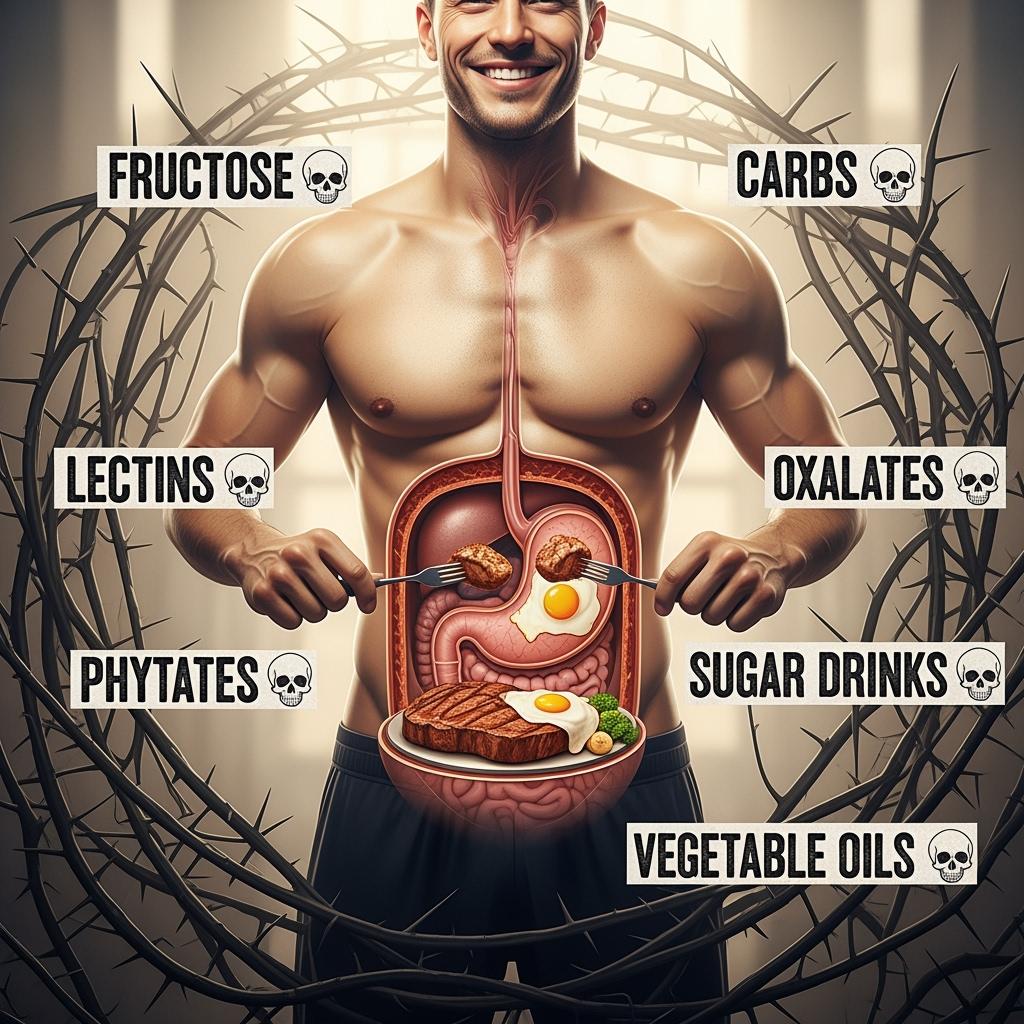
My body rebelled against plants
For most of his adult life, Doug chased health truths like an archaeologist unearthing relics—sifting through trends, peeling back misinformation, and experimenting on himself. He ventured into the verdant realm of plant-based living: kale smoothies with spirulina, elaborate salads of lettuce, tomato, avocado, green pepper, spring onion, papaya, sweet potato, and feta—topped with crispy bread squares and sprinkled with life-adding turmeric and olive oil. Sushi platters, seaweed wraps, and flaxseed oils added exotic flair.
Despite the colourful plates and nutrient charts, Doug’s body spoke a different language. His energy flagged. Joints ached. His digestion felt like civil war. And he sensed early-onset dementia knocking on the door. Blame was placed on detox, adaptation, aging. Aging especially. Everything but the diet. No one ever considered the real culprit.
He did. One sleepless night, doubled over with bloating and a strange burning in his gut, he whispered to the darkness:
“What did I do yesterday that my stomach rages against the green?”
Not Built for Foliage
Plants are as alive as animals. But being unable to flee, they evolved chemical warfare. Oxalates, lectins, phytates—strategic compounds that deter herbivores and lock away vital minerals and micronutrients. These aren’t minor irritants. They’re biochemical tripwires.
Doug discovered how these subtle saboteurs wreaked havoc. Oxalates didn’t pass through—they accumulated, forming glass-like crystals in his joints and tissues. Lectins inflamed his gut lining. Phytates bound minerals like iron, magnesium, and zinc before his body could absorb them. Even fibre, hailed as a digestive hero, turned against him—tearing sensitive stomach lining and causing bleeding.
His vision blurred, thoughts fogged, and moods flattened. Carbohydrates compromised his lungs, contributed to fluid buildup behind his eyes, and accelerated macular degeneration. Fructose wreaked havoc on his gums and teeth. Worst of all, his mental acuity dimmed—the joy of freedom from depressive “downers” and foggy clarity became a distant memory.
Plants, he came to understand, “choose” their consumers. They build a symbiotic relationship with species that best meet their survival needs. This ancient supplier-consumer bond ensures only select animals can truly digest their offerings. The rest? They’re handed nutrients wrapped in toxins.
Evolution’s Gatekeepers
Nature never intended a free-for-all in the garden. Ruminants can slowly ferment select leaves. Hindgut fermenters like horses break down some fibres. Yet even among them, feeding patterns are precise. Kudu and waterbuck, sharing the same African valley, graze on entirely different foliage. Koalas eat eucalyptus—or get sick. Mangrove trees, rooted in ancient Southeast Asian swamps, permit only a handful of species—like the proboscis monkey—to nibble their leaves.
If trees can choose their predators, wouldn’t a sharp-eyed detective conclude that humans, never truly invited to the plant banquet, have been trespassing all along?
The Furnace Within
The human stomach isn’t a salad bowl—it’s a forge. Acidic. Ruthless. Built to dismantle flesh, not ferment fibre.
Doug remembered a six-week army camp deep in the Zambezi Valley, bordering Zambia and Rhodesia. Meals were blunt: bully beef, eggs, and army biscuits dunked in hot water. He felt lean, strong, and mentally alert. At the time, he wrote it off as forced scarcity—until he went full carnivore two years and nine months ago.
That was when he finally asked:
“If food is fuel, what kind of engine am I running?”
The Shift: Honouring Evolution
Doug cleared his fridge—no more greens, reds, yellows, whites, or blacks. Out went the vegetables and fruits, lovingly selected from Ampang’s Fresh Market. In came wild foods: grass-fed beef, buffalo, mutton, pork, village chicken, salmon, and eggs upon eggs. Butter and tallow replaced olive oil.
Within days, the rebellion ended. His stomach fell silent. Bloating vanished. Sleep returned. Energy surged. Most remarkably—his mind sharpened. Confidence bloomed.
Doug’s no scientist, but he’s observant. He resumed writing—tracing evolution through bones and brains: how early hominids scavenged marrow, how nutrient-rich meat expanded our cerebral cortex. Fire and tools weren’t just breakthroughs—they were responses to meat hunger.
Against the Grain
Social backlash arrived quicker than meat delivery. Doctors shrugged. Friends frowned.
“Fiber?”
“Fruit is vital.”
“Where will you get antioxidants?”
“The cholesterol will kill you.”
Doug didn’t argue. He shared his truth. He sought no converts—only alignment between his biology and behavior. Now, after nearly three years of fasting daily, friends ask how this much older man climbs jungle trails faster than they do.
“Ha,” they giggle, “it’s the fasting!”
But that’s a misnomer—nearly as misleading as the claim that humans are omnivores.
Fasting is not ancient—it’s a relatively recent behaviour. It means refraining from vegetables, carbohydrates, and fruits for a set period. But for a carnivore, that restraint is automatic. A meat-heavy meal takes 14–16 hours to digest depending on exercise and cut. Withholding more food simply lets the digestive furnace do its work uninterrupted. That’s not discipline—it’s design.
Epigenetic Shadows
This story isn’t just about Doug. It’s about generations. Cat and mouse studies prove plant-heavy diets erode immune strength, damage organ function, and weaken reproductive health—litter by litter. Epigenetic changes—chemical marks on DNA—alter gene expression based on diet. Damage multiplies across generations.
Doug saw it in his own lineage. Allergies. Infertility. Mood disorders. He now believes plants—especially maize—compromised the once-powerful and beautiful black African body, rendering it vulnerable to diseases like HIV. A virus our ancestors may have coexisted with for centuries—only erupting in bodies severely weakened by agricultural change.
Where Dr. Beetroot once championed vegetables as healing agents, Doug flips the narrative. It was the very plant-heavy diets that broke immune defences and opened the doors to viral invasion. And still, the world pushes grains and greens.
The irony? Everything we’re told plants offer, animal foods provide—already processed by specialized stomachs, ready for seamless absorption.
Writing the Last Chapter
Doug is crafting his short book—not a manifesto of meat, but a memoir of clarity. A chronicle of missteps and revelations.
The fire in his stomach. The wayward mind. The uneven temper. These weren’t malfunctions. They were messages. Signals. Warnings.
A truth buried deep in time:
We are designed by evolution, not diet trends. And our biology remembers.
We are not what we eat.
We are what we absorb.




 Douglas Schorr
Leave a comment