
Isn’t it time for you to reconsider law through the lens of human evolution?
Bulawayo, 1966, 3 a.m. I sat shivering beside my mentor. We’d stopped at a deserted red light, our vehicle carrying a freshly butchered kudu. “Just go. Everyone’s asleep!” I whined. His response was my first lesson in the true nature of law.
“The moment we decide some rules don’t apply to us,” he said, “is the moment civilization begins to unravel. We’ll invent new exceptions. Soon we’ll crown ourselves kings.”
“Shucks, if a policeman spots us, the chances are we’ll know him.”
“Huh! When those tasked with upholding the law start looking the other way, it’s time to emigrate!”
That red light became my compass.
The Original Covenant
Six million years ago, our ancestors made an evolutionary gamble unprecedented in Earth’s history. Leaving the safety of the trees, these proto-humans found themselves in a hostile environment with neither claws nor fangs nor impressive strength. Their survival depended on something radical: cooperation through mutual obligation.
This wasn’t abstract philosophy but practical necessity. In those ancient savannas, everyone needed to contribute more to the group’s welfare while receiving its protection. This reciprocal relationship—duty matched with rights—became the foundation of human society.
From this emerged the profound understanding: there exists only one true crime—theft.
Not merely taking objects but violating the covenant of mutual obligation. When you fail to contribute, when you harm rather than help, when you take without giving back—you steal from the collective human project.
The Natural Law
This understanding wasn’t recorded in books or carved in stone. It lived in the daily practices of communities worldwide, expressed through a million daily choices. It’s why so many isolated cultures developed similar prohibitions despite never meeting. They weren’t copying each other—they were responding to the same fundamental reality of human interdependence.
Consider how our ancestors defined theft in what became known as the “common law.” Neglecting your responsibilities. Abusing those in your care. Destroying rather than creating. Consuming without contributing. Looking away when action was needed. All these violated the same principle—the obligation to improve oneself for the benefit of all.
Modern legal systems, with their countless statutes and regulations, are merely elaborate categorizations of this one essential crime. The prohibition against murder isn’t primarily about the act itself but about the theft of a life from family and community. Laws against fraud protect not just property but the trust that makes cooperation possible.
Throughout history, societies developed complementary approaches to enforcing this covenant. European traditions emphasized punishing violations—identifying and sanctioning theft in all its forms. Chinese traditions focused on celebrating contribution—recognizing and rewarding those who fulfilled their duties exceptionally well.
These aren’t competing systems but two sides of the same coin. Both acknowledge the fundamental principle: human society flourishes when each person embraces their obligation to contribute more while respecting others’ right to do the same.
The Modern Disconnect
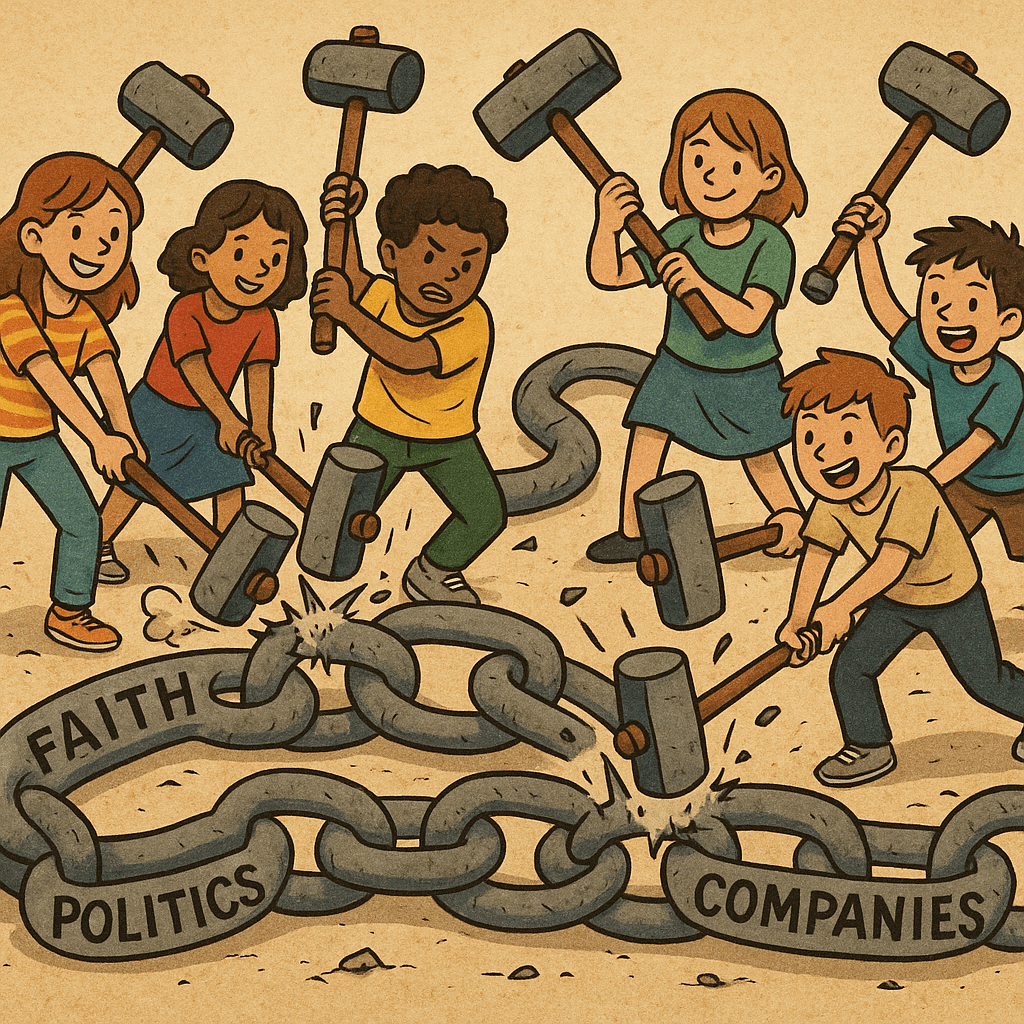
We’ve lost sight of this fundamental principle. Our legal systems have become procedural rather than purposeful, focused on technicalities and open to manipulation rather than the protection of mutual obligation. We warehouse offenders at public expense rather than requiring meaningful restitution. We separate rights from responsibilities, creating constitutional frameworks that emphasize entitlement while minimizing obligation.
From corporate executives who destroy livelihoods without consequence to politicians who sacrifice public good for private gain, from individuals who demand rights while rejecting responsibilities to communities that tolerate persistent violations of the social contract—we are witnessing the systematic theft of our collective potential.
Most troubling is how we’ve abandoned the transmission of these values to the next generation. Parents, fearing accusations of strictness, hesitate to enforce boundaries that would teach children their obligations to others. Schools emphasize self-expression over contribution. Popular culture celebrates taking rather than giving.
The Path Forward
Recovering our balance requires returning to first principles. We must recognize that rights and duties are inseparable—like fingers and thumb, each useless without the other. A society that emphasizes rights while minimizing duties creates inevitably unstable systems.
This isn’t about punishment but preservation and progress. When we hold each person accountable for their contribution to the collective good, we aren’t being harsh—we’re honouring the fundamental compact that makes human flourishing possible.
It requires us to reconsider how we respond to violations. Natural justice demands more than symbolic sanctions; it requires meaningful restoration. When someone steals from the community—whether through violence, neglect, or exploitation—they and all who benefited must make the community whole again.
It also requires us to celebrate contribution as vigorously as we condemn violation. Those who consistently fulfill their obligations, who improve themselves to benefit others, who strengthen rather than weaken social bonds—these deserve not just our respect but our emulation.
Conclusion
During my tenure as a junior civil court magistrate, I faced a case that crystallized these principles. A woman sought divorce after years of documented abuse. He, promising reform, argued that Catholic doctrine superseded the civil court. In ruling for divorce, I recognised that when any system—religious, political, or otherwise—attempts to legitimise the theft of another’s fundamental humanity, that system has exceeded its rightful authority. No doctrine crafted by humans can rightfully sanction such theft.
The traffic light in Bulawayo wasn’t about road safety. It represented something profound—the understanding that civilization depends on each person’s commitment to mutual obligation, even when nobody seems to be watching.
Our ancestors understood what we’ve nearly forgotten: human flourishing emerges from achievement that ripples outward. The law doesn’t constrain potential—it protects the environment where potential becomes meaningful. As your capacity grows, so does your ability to strengthen the community that enabled your success. The entrepreneur creating jobs, the expert training apprentices, the leader developing future leaders—each transforms personal achievement into collective advancement. This is civilization’s engine: an ascending spiral where individual excellence and community welfare continuously reinforce each other. Law exists not to limit this process but to safeguard it, ensuring that our intricate web of mutual obligations remains strong enough to sustain our continued evolution.
When we recognize that all crime is theft and all law is the protection of mutual obligation, we recover not just a legal principle but the very foundation of human society. In this recognition lies our best hope for creating communities that truly thrive—where each person embraces their duty to contribute while honouring others’ right to do the same.






 Douglas Schorr
Leave a comment