The Savannah’s silent war comes home: how armchair humans added TNT.
The lions crouch, eyes locked on a massive African bull elephant. Rich in iron, zinc, and fats, an elephant fuels a predator’s fire. If only it would trip, get a headache and lie down. Idle thoughts in the savannah heat. Today’s meal will likely be zebra, wildebeest, or a warthog snack–always nearby, often distracted, easily caught. Convenient, but not as nutrient-dense or mineral-rich.
Picture yourself there, camera in hand, waiting for the kill: finally, bloody muzzles, hyenas waiting in line, circling vultures, and ants tidying up. Nature’s brutal balance. Yet uninvolved in this spectacle, the elephant, majestic and intelligent, unknowingly wrecks this ecosystem. Survivor and saboteur, it stars in a drama older than gods–until humans meddled.
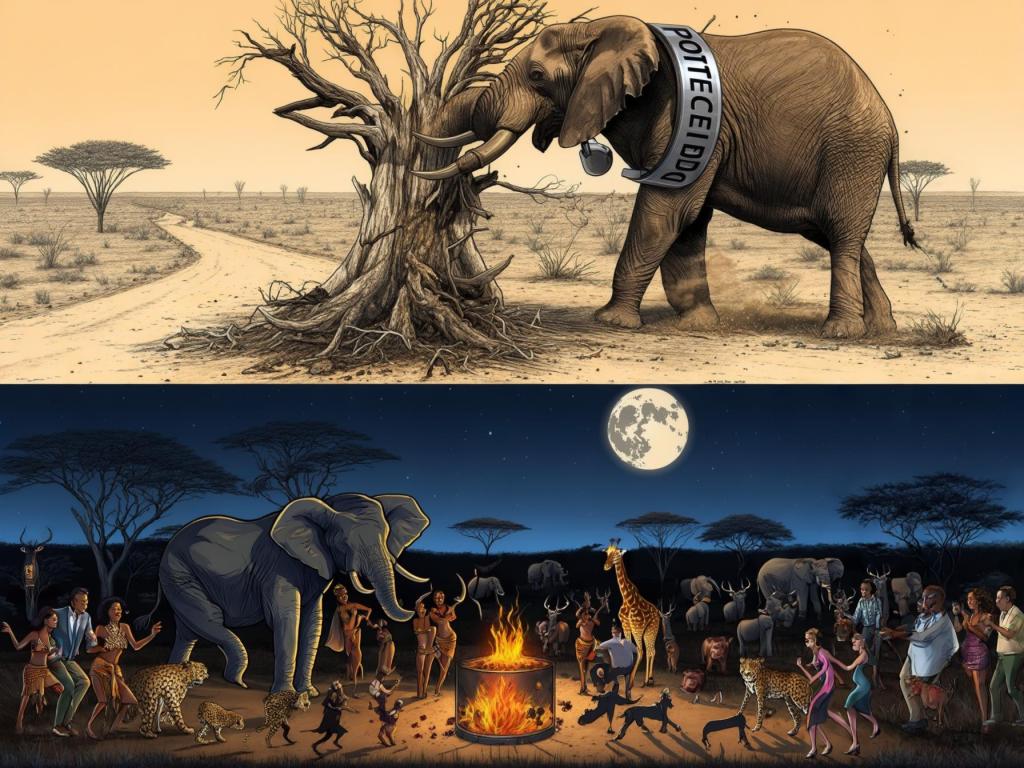
Believing they know better, they interrupted Earth family business. While theoretical armchair conservationists shed tears over magnificent beasts, both elephant and misguided human devastate the very ecosystems they claim to cherish. The African bull wraps his trunk around an acacia tree. With a crack, the tree surrenders–a meagre meal for a colossus built for forests.
Millions of years ago, elephants thrived in lush forests, munching tender greens. Then ice ages shrank their buffet. In Africa, savannahs took over. Because they couldn’t bring back warmer, CO2-packed times, Mesdames Evolution and Nature collaborated on the exterior package. African elephants grew taller with longer trunks, developed tree-crushing strength, thicker molars for woody roughage, and enormous bodies to survive droughts. Their ears expanded to dissipate savannah heat. But Father Complicity shrugged at upgrading their digestive system. “It’s working okay–leave it,” He growled.
True enough, elephants had a special hindgut fermentation arrangement, and so even though savannah fare is nutrient-poor compared to forests, Eli gets by. The problem is elephants travel in herds, everyone shovelling in enormous quantities of vegetation.
This evolutionary compromise produced elephant meat rich in brain-building fats and proteins that fuelled human evolution. While lion ancestors looked on amazed at this puny hairless ape’s skill, our ancestors didn’t petition to protect mammoths–they feasted on them, setting up home beside carcasses until the last morsel was consumed. We were a major factor in the mammoth’s Eurasian disappearance. Yet in sub-Saharan Africa, as elephant guts churn like cement mixers, desert creeps in behind them like death’s shadow…because they’re protected.
The Bantu mostly ate antelope and buffalo–plentiful and easier killed. And with their multi-chambered stomachs, they offered meat with the full range of nutrients. Nothing processes minerals and micronutrients as efficiently as the ruminant. That left African elephants pushing over trees we thought had Australian roots, while modern economy participants gleaned energy from domesticated meat.
And would you believe that with a dash of help from the powers-that-be we botched it. Pigs, once earthy omnivores, are now forced to gorge on corn, soy and other processed junk under EU rules, becoming industrialized fast food on hooves. First World farmed pig is better than vegetables, fruit and carbohydrates, but it’s marginal. Nutritional value drops with each generation of agricultural “improvement.” As your pork chop sizzles, note that ruminants–cattle, sheep, and goats–our energy champs, are now suffering the same fate–all for profit expansion and GDP growth. Supermarket plastic wraps now proudly proclaim “corn fed,” and the roboticized human buys!
This “understand your stomach” business is extremely important, but politics, religion and emotions decided 4 billion years of Trinity work was wrong! They silence professionals who suggest wildlife population control through standard stock farming “off-take” selection. “Culling” elephants became blasphemy while desertification rolls past unnoticed.
Where are we now? The Trinity’s careful work–evolutionary adaptation, natural balance, necessary compromise–lies shredded by human arrogance. It is as though we see value in a luxury goods billionaire’s advice about running our homes and communities.
Do you see how compromised decisions, accepted misinformation, savannah and elephants, and failing communities tie together? Remember your dad saying if cops let people run red lights, they’d soon forgive shoplifting? Not the cops, but ordinary folk being ornery. It’s all wrapped in the same gross mismanagement parcel.
We were on track: early European conservation reserved wildlife for aristocrats. America created public preserves while telling poorer nations to cut trees. Rhodes set aside Africa’s first controlled hunting/protection zone in Zimbabwe. Likewise, President Theodore Roosevelt understood sustainability required management, not mere preservation. But this philosophy was dumped when those with voices and newfound spending power dictated these zones become hands-off reserves. Somehow, they missed that animals fighting tooth and claw to delay a nasty death is worse when human constrictions add hardship. Game parks are not cushy zoos with room service, veterinarians and time to think.
What if we reconsidered conservation through pragmatic coexistence rather than untouchable reverence? That’s tough to ask modern economy specialists living in concrete beside tar whose shopping heads home in plastic, but I must. You’re voters. Democracy is crazy–90% have opinions yet no idea of the stakes. I’ve advocated converting South Africa’s maize and sugar belt into stock ranches. Now it’s your turn. Won’t you tell “them” to reconsider wildlife conservation? Shouldn’t wild animal farmers take this baton?
Controlled elephant farming–managed with wildlife ranching standards–will engage critically required community development, spin into urban areas, create jobs and eco-tourism while simultaneously:
– Reducing habitat destruction through sustainable elephant populations
– Providing exceptional nutrition to local communities
– Creating conservation incentives
– Restoring ecosystem balance
We already claim to drive earth’s ecosystems. With this approach, experts can apply thoughtful management, acknowledge that moral posturing has consequences, accept that the Trinity rules and that 75% of South Africans need help.
This elephant dilemma mirrors South Africa’s governance crisis perfectly. Like “conservationists” prioritizing emotions over ecology, politicians peddle appealing narratives while the nation collapses. BEE policies and welfare destroy more human habitat than a parliament of elephants ever could.
Why the surprise when Ramaphosa’s crutch, billionaire Johan Rupert, allegedly suggested to President Trump that drones and Starlink would fix crime? Does he offer his inherited estates to house those caught by surveillance? Will he get stuck into rehabilitation and reskilling or simply shout, “Gender violence”? What in his luxury empire enables actual human flourishing?
Farming elephants sounds radical until you realize it acknowledges sustainable systems require balance, not intervention. Marriages need jobs, not piffling welfare. Doctor visits should be for stitches, not metabolic collapse from poor nutrition. Social systems should thrive through inherent equilibrium, not constant props like BEE. The solutions await humans humble enough to act with love–tough love.




 Douglas Schorr
Leave a comment