In 1954 in a Bulawayo (Southern Rhodesia) backyard, three worlds collided.
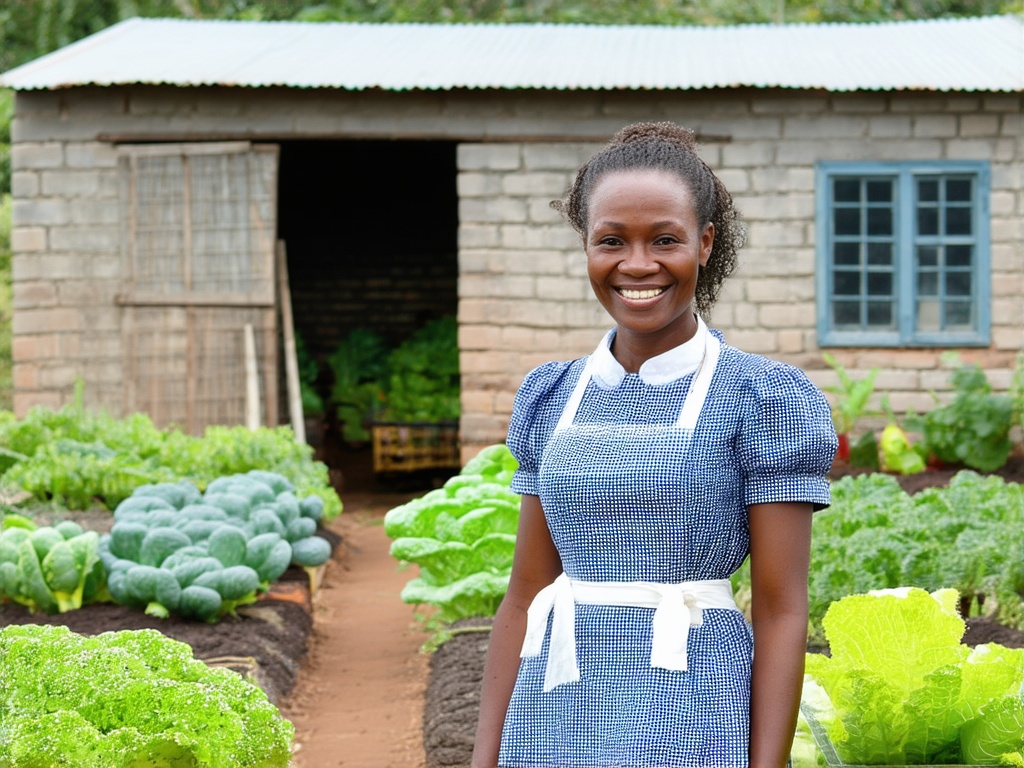
Jabulile Nyoni (black African) stood proudly in her crisp, blue-checked uniform and white apron. She had been so excited when my mother (white African) had come from work and presented the outfit that she insisted on changing from her ‘hand-me-down’ sundress right away. And just in time. Her hair still damp from the shower, she was about to startle my dad’s new boss and trigger an unexpected revelation about the invisible boundaries we all lived within.
Dad was leading the 25-year-old, a fresh product of an English university’s electrical engineering degree course, an Englishman who’d never seen an African sunset, from our plain front garden to ‘Dad’s Delight,’ an extraordinary vegetable garden that dominated the back.
I couldn’t grasp the la-di-da, but Dad said later he was explaining ‘allotments’ when Magdalene’s courtesy and gentle “Good evening, sir,” and my father’s spontaneous, “Why, you do look like the Queen of Mzingwane, Magdalene,” set her giggling and stopped him in his tracks.
If I’ve confused you, Magdalene is her Christian working name and Jabulile her given name at home in the Tribal Trust Land. It was as Jabulile her journey with us began. Her grandmother Beauty was my nurse as an infant in Gwanda where my father worked at the district power plant. When Dad’s transfer took us to Bulawayo, we first lived in one of those hastily constructed mud houses built for WWII airmen—emergency accommodation still housing families like ours nearly twenty years later. After a year of cramped quarters and part-time help, we relocated to the modest three-bedroom home in Hillcrest. Before we’d even moved, word arrived from Gwanda that Magdalene, the alias that was to appear on her all-important ‘Headman’s letter,’ sought permission to work for us. Remembering the quietly spoken, willing worker—not the type who sat passively drawing in the sand—who visited her grandmother years earlier, Mom agreed right away. “Getting ‘known’ help is so important,” she explained.
Magdalene’s khaya—Matabele for ‘home’—sat beyond Dad’s meticulously tended vegetable garden. ‘Her khaya’ in that it came with the job, just as ‘our’ house was part of Dad’s package. The rectangular structure was simple but functional: half comprised her living space with a window and electric ceiling light, while the other half -also with a single electric light, was split into a passage that doubled as an eating area with the remaining quarter blocked off into a squat toilet and shower, and cooking area with a rudimentary chimney. All in, it was near exactly twice the size of the bedroom I shared with my brother – her private space in our family compound. Well, almost. She shared with Enock until Dad helped him get a job at a market garden outside town. Enock’s nephew Samuel took his place.
Their khaya stood along our property line, positioned directly opposite our neighbour’s khaya. From there, beautiful pennywhistle melodies drifted over the fence on many an evening. I’m convinced somehow his rendition made it into The Lion King soundtrack. That fateful evening when the man who had yet to have a sunburnt neck came to admire our vegetable garden, there was no music.
Something about Magdalene captivated the Englishman. He impulsively asked to see her quarters.
I’ll never forget his face when he emerged. Behind him, Magdalene trembled, her lip quivering uncontrollably as he catalogued what he considered his scholarship-winning classmate Mandla Mbeki would describe as appalling conditions: the bare ceiling rafters, concrete floors, proximity of cooking fire to ablution area, and Samuel’s pallet bundled in the corner. But it was his criticism of her personal treasures— her bed propped on bricks (against the tokoloshe), the sagging curtains (she’d proudly sewn), and stools from her distant homeland (carved by her dad)—that broke something inside her. With an anguished cry of “Madame!” she fled up to Mom at the kitchen door, and with tears streaming, wrapped her arms around her.
She was too big to be hugged by my little mom. Undoing Magdalene, Mom pushed her gently into the kitchen, and, with her shoulders squared, she turned, the back step her dais. But as Mom opened her mouth to respond, her eyes flashing nuclear strike, the engineer’s face flushed crimson. He shrank, and stammering apologies, retreated hastily, leaving us frozen in bewilderment at the garden’s edge.
From the khaya, a cowed Samuel edged up, and squatting, began raking up Syringa berries with his hands. I can’t squat, but I bent low and raked too. They were a perpetual problem, those dang berries. Sure, the tree grows fast (for a hardwood), and it shaded the kitchen from the afternoon sun, but they’d proved themselves to be an invasive rather than cooperative plant. It was a really dumb import by the government.
In the cradle of indigenous-settler Rhodesia, our backyard, like most, was a microcosm of cultural evolution—traditional tribal practices meeting European sensibilities, creating something altogether new in the process. It was complicated enough without some young academic bull bellowing and trampling the fences of a paddock it knew nothing of as it searched for the gate.





 Douglas Schorr
Leave a comment