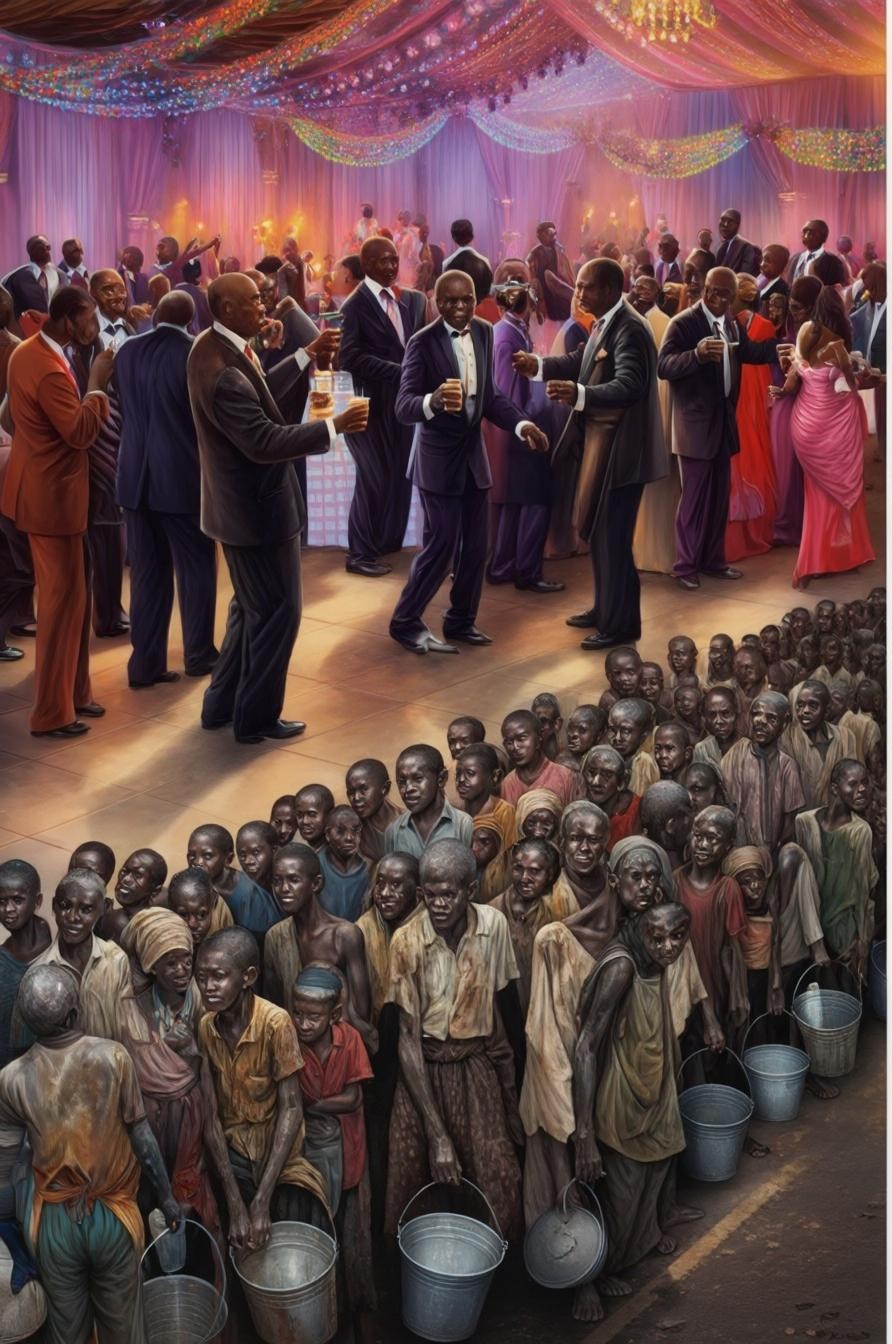
A harsh truth: when biological reality collides with political ideology, dysfunction results–but there’s a path forward.
My Irish great-granny arrived in “darkest Africa” in the 1880s expecting chaos, only to find a land buzzing with promise. “Some towns had lights before London! It was a place that was going to astound,” she said to me in her Durban apartment in 1965.
“The connected economy you live in of electricity at the flick of a switch, interconnected ports, roads, rail, phones, factories, mines, farms, hospitals, and schools were all seeded then,” enthused Mary.
What a pair. My wizened, round-shouldered great-grandma and Mary, a handsome, tall, 64-year-old Xhosa lady.
“I don’t think tea is enough for this boy, Mrs. Jones. I’ll do him a plate of bacon and eggs—look at the size of him! So much bigger than my Muhle, but then all his mother gives him is mpuphu!”
“Please sit and explain to him this urbanization stuff. When I tell of all the smart folk coming in from the homelands to try this modern living business, you tell me I’ve only got half of the story.”
“Let’s compromise. You tell him about horses on Smith Street, and I’ll give him a history lesson while he’s eating.”
Two hours later when I stepped onto super-busy Smith Street, I imagined it as a dirt track just 60 years before, where cars only replaced horse carts around 1930. Suddenly I appreciated what I’d taken for granted—lights for homework, factories operating around the clock, and a rand strong enough to import what local talent couldn’t make cheaper. And outside of intertribal conflicts—mostly on the mines—the country was quiet; crime was mostly petty. As Mary explained, as white Africans developed cities, black Africans were drawn from their homelands to jobs and modern living—as dramatic a change as Britons experienced during the Agrarian Revolution, except the English were forced.
Sixty years have passed. To Mary’s explanations I’ve added study and experience of Africa’s unique place. For 45 years I watched Zimbabwe deteriorate. For 30, the ANC has overseen what was Africa’s model industrialized economy. Now, Malawi, the world’s poorest country, is safer. How has the ANC achieved this reversal?
It isn’t just that the leadership cannot cope. For over a century, throughout Sub-Saharan Africa, leaders sought ideas from ultra-liberals—today’s woke. The concepts fed to emerging black elites—communism, affirmative action, quota systems, minimum wages, unrealistic educational programs, and centralizing the very essential services the poor need beside the corner shop—failed even for Germany, Russia, and China. American scholars like Williams, Steele, Sowell, McWhorter, and Hughes note these warm classroom theories fail in the streets. And African streets are in worse condition than anything in the West.
The ANC plucked people from a two-dimensional tribal lifestyle developed over thousands of years and set them alone in a place demanding completely different skills. In modern terminology, an IQ of 70 plus bush education was adequate for hunter-gatherers. But in a modern economy, 70 equates to the coping ability of a 10-year-old. That’s biology. Given sub-Saharan Africa’s isolation and abundance, there was no evolutionary pressure to develop mental capacity for a modern economy. Now, to function independently, an IQ of 100 is required. The change in thinking required is huge, beyond evolution’s ability to deliver quickly. Simply put, most need help.
The challenge the woke and African nationalist leaders refuse to accept is that these proud people aren’t lazy—they genuinely don’t know how to navigate a modern economy. One-on-one, I’ve managed to get foreigners to imagine being 10 again while trying to support a family. Then they meet a guy or gal studying for a BSc or a 20-years-on-the-job professional, and suddenly the notion that all blacks are equal re-roots. My work in Rhodesia taught me they genuinely needed help. The problem is: where will this help come from?
In South Africa, even assuming a national average IQ of 80 rather than 70, of 50 million black Africans, only about 5 million have IQs above 100 but below 110, and 1.14 million exceed 110—totalling 6.14 million. After adjusting for age, gender roles, and existing employment as seniors, SA faces a 540,000 “shortfall” of potential visionaries and lawmakers!
Wow! Forget about asking who’s willing; who’s available to help the 30 million?
At best the economy is represented by a wheelchair warrior in an international marathon. And still to be deducted are those facing the inordinately high levels of health challenges.
None of this means SA lacks smart black South Africans. The issue is there aren’t enough, evident when observing cabinet decisions, legislative dysfunction, and cadre deployments to senior posts. While the cabinet acts like gods, the most critical failures occur municipally—where daily life happens. ANC-controlled municipalities are bankrupt, but they do now have an ANC membership smart card.This isn’t what voters need.
They need visionaries in cabinets, MPs who minimize laws and action those they pass, competent management of water, sanitation, food security, schools teaching skills, police and clinics on every corner, and capable municipal officials.
Despite the ANC, South Africans of all backgrounds have struggled to build economic relationships. Although reasonably successful, too many capable guides have called time. That’s critical because welfare dependency must be inverted; instead of receiving aid, the poor need to be enabled to contribute … even if it is only 1c a day. The people are proud; they didn’t want to be beggars—welfare is a woke-nationalist easy solution.
Ironically, while South African sports teams review performance to emulate the world’s best, politicians do the opposite. They blame models—colonialism, etc.—instead of building on them, becoming vengeful. In this, the woke have been supportive. Non-blacks who remained have been sidelined, their skills locked away. Looking east is an option: China can do miracles but wouldn’t teach—they’d do the work themselves, relegating the 75% of locals who can work but with supervision to Harari’s ‘useless class.’ There will never be another opportunity to work together with people who know each other as happened – in English!
“One person, one vote” isn’t democracy when most voters have the mental age of 10. At best, it’s transferring proxy votes to parties that convince voters they represent their traditional kings. The irony is that woke academics don’t understand that 18th Century Xhosa and Zulu were successful because they ran a savannah form of capitalism—better expressed as the ‘proper allocation of human resources for maximum human flourishing given prevailing circumstances.’
Is there an alternative? Yes—a 2-step process:
Declare war on western political culture and do the opposite of what would destroy SA quickest.
When the ANC finally scraps capitalism, SA will drown.
To avoid drowning, cut the Western sham. Scrap party politics, parliament, and provincial assemblies, and shake up all ministries. Education and health have already collapsed, but social welfare and defense must also go.
Elect a Commander-in-Chief President empowered to appoint the best brains and business leaders to the cabinet, business generals to manage provinces, and entrepreneurial colonels to run 400 municipalities/districts with (say) 3,000 community development centers.
Recall my SANNA post—”What if South Africa offered its struggling citizens a place in a new national army?” Read it quickly, because skilled South Africans of all races today sit and plan their next move: How best to take advantage of Trump’s offer?




 Douglas Schorr
Leave a comment