We’ve forgotten that our intelligence wasn’t gifted; it was earned through millions of years of challenge and adaptation.
In the history of the world, humans achieved the unprecedented: minds capable of understanding our own evolution, complex technologies, and reshaping the planet itself. Now at our peak, we’re witnessing the dimming of our cognitive powers.
The journey begins not with humans, but with a fundamental principle established 3.5 billion years ago. When the Trinity – Father Complicity, Mother Evolution, and Mother Nature – sparked life on Earth, they created a universe of competition. Even siblings fought for identical resources. Success demanded mastering four fundamental challenges: Producing offspring, Parenting them, Protecting and Providing for them.
Our earliest ancestor (Eve in the west), asked for help. The Trinity’s response was specialization. Females managed production and parenting, males handled protection and provision. Now, inseparable couples competed as teams against all others. Leap forward to our beginnings.
When the dinosaurs were wiped out 66 million years ago, the catastrophe transformed Earth into a greenhouse world. In this warmer, CO2-rich environment, plants flourished and mammals diversified and thrived. Our ancestors began their remarkable transformation, evolving into tree-dwelling primates – “Wood Apes.” Like all mammals, we enhanced our 4 Ps by developing crucial baseline intelligence: understanding seasons, food sources and locations, competitor recognition, and territory boundaries.
As Earth cooled again, ice claimed the poles, forests shrank, and deserts began forming. As primates migrated south, one group made an extraordinary choice that would reshape the story of life on Earth – they left the trees.
This wasn’t just a change of habitat – it was the beginning of humanity’s greatest challenge. Everything we knew, every skill we possessed, was optimized for life in the trees. On the ground, we were the worst-equipped predators ever, yet this disadvantage sparked our greatest advancement – we had to think our way through every challenge, every day.
Our constant problem-solving attempts triggered an unprecedented response from the Trinity. They began building something new atop our animal brain – a thinking mind capable of conscious decision-making. Though it would take millions of years to be useful, it was a start. We apprenticed ourselves to scavengers, learning from hyenas and vultures. This simple step proved revolutionary – combining our desperate need to think with exactly what our growing brain needed – increased access to meat and fat. Our digestive system evolved to match, and our transformation from ground-based ape to early human accelerated.
Where other predators had evolved specialized hunting brains operating on instinct, we had to open a road never before travelled. Every hunt presented new problems requiring conscious solutions. Every success brought more challenges – how to get the family to it, to eat it in peace, how to access the marrow… a big rock?
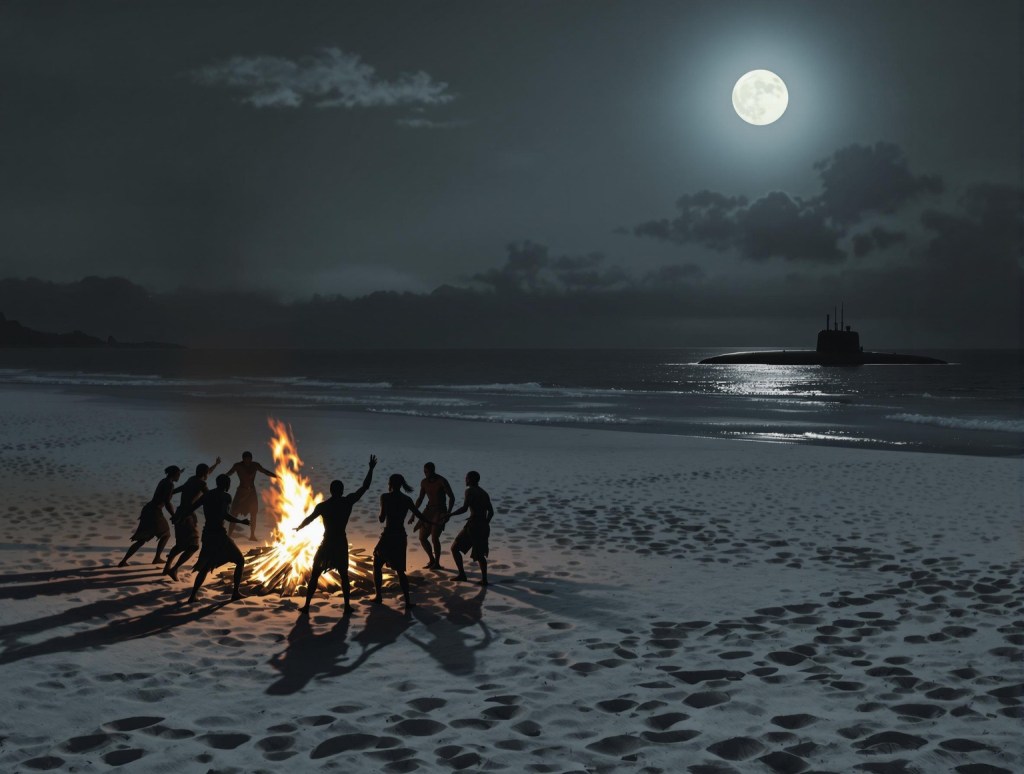
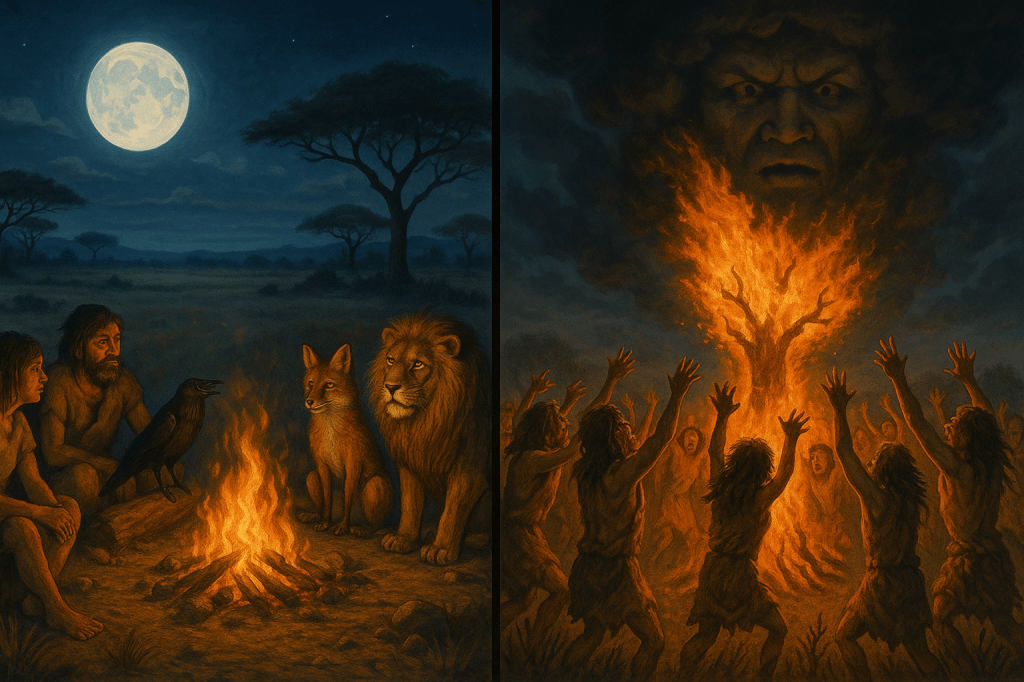
The mastery of fire marked a quantum leap in our development. Beyond warmth and protection, fire fundamentally rewired our minds. Those extended evening hours became our extra-tuition classrooms, where knowledge transfer through mime, dance, and early vocalizations flourished. Cooking meat made it more digestible and energy-efficient. Our brains, already growing from problem-solving demands, now had access to unprecedented nutritional resources. Fire itself was a brain-teasing problem: keeping flames alive meant cooperation, organizing gathering parties for fuel, designating fire-tenders, and developing methods to transport embers between camps. New forms of social interaction and communication emerged. The combination created a powerful feedback loop: better-fed brains with more cogitation time could solve more complex problems, leading to better hunting techniques and more nutritious food.
This early mindfulness birthed something revolutionary – the development of “what if” thinking. Perhaps around the fire, we began playing simple questioning games with the first gods we created. These mental exercises evolved into actual planning: “What shall we do tomorrow?”
The paradox of our restricted communication – limited to grunts, gestures, mime, and dance – actually drove innovation. Unable to simply tell others what to do, each generation had to demonstrate, repeat, and improve upon basic skills. Tools became more sophisticated not through verbal instruction but through active problem-solving and demonstration. We sought continuous improvement rather than mere replication.
But progress wasn’t linear. As living conditions improved and basic needs were met, groups grew larger and more secure. They discovered the comfort zone – that seductive state where survival becomes routine. Mental development slowed. As populations expanded beyond our management skills, groups split. Most followed the east-west line of similar climates, meaning hundreds of generations passed with identical solutions serving identical problems. Then came a revolution – we unwittingly opened what we might call the Eurasian University of Higher Learning.
While most were content in the comfortable life of equatorial Africa, perhaps beginning 250,000 years ago multiple waves of small bands headed north into Eurasia. Many more groups followed, though they had no knowledge of those who’d gone before. Each faced unprecedented challenges that shocked them out of their comfortable thinking patterns. Those who settled along the southern Mediterranean shores and in the Fertile Crescent found relatively familiar conditions. But those who spread across Eurasia’s varied environments entered a world demanding entirely new solutions. These pioneers faced challenges that would have been insurmountable to their ancestors. The result – an intellectual explosion.
Each new environment – from frozen tundra to dense forests, from windswept steppes to coastal regions – presented unique problems requiring novel solutions. Fail to graduate that year in the great university, and you died. This wasn’t gradual adaptation; it was rapid problem-solving under extreme pressure.
Physical adaptations emerged alongside cognitive development. Skin color change to optimize vitamin D production was a universal adaptation across northern regions. Within a relatively short evolutionary timespan, spread over Eurasia and the Indian sub-continent, the groups began looking remarkably different from each other. Yet these variations were literally skin deep. The Dutch indeed share closer genetic ties to many East Asian populations than some African tribes living beside each other. But by 15,000 BC, surface differences had convinced people they were looking at different races. A new round of the “Art of Becoming” was in full force.
Cultural diversity exploded as each group developed unique solutions to their local challenges, including creating gods to be consult and be controling. Yet remarkably, the pace of change remained similar across different regions. Why? Because they were growing their intellectual capabilities at roughly the same rate as they responded to problems of similar complexity. And the feedback loop fed the language leap.
The improving ability to speak one’s mind changed everything. The simple gestures, mimes, and music of Africa evolved into words, and words into descriptions, each shaped by its users’ specific needs. More than communication, this was the beginning of harnessing the ability to transfer complex thoughts and abstract concepts. For heaven knows how long, we had been unable to express the data in our imagination – that’s the amazing, powerful place of our individuality.
Unlike other predators who reached their cognitive peak when their hunting was perfected, humans kept extending group and personal boundaries beyond mere survival. But then came a crisis – the disappearance of the big game, our fuel.
Those enhanced minds turned to agricultural innovation – domesticating animals and plants. This wasn’t just adaptation; it was humans attempting to replace the Trinity’s management of life itself. We settled permanently, created the first civilizations, and began the great copying experiment. Not just to copy their neighbours’ innovations but to improve upon them, creating cycles of advancement. Sadly, not everyone followed this path.
The great divergence between black Africa and non-black populations widened. While Eurasia roared into modernity, sub-Saharan Africa’s improvements were marginal and minimal. The transformation of the Sahara into desert severed connections; each forgot the other. The isolated Americas developed their own path. While Eurasians leapt at transformative challenges and looked for more, their very success was planting seeds of tragedy.
Today, we face a crisis at the core of what made us human. Unprecedented wealth through debt and materialism has trashed the convention of the 4 Ps, and the comfort-seeking behavior that derailed us before is back in force. The very things that built our intelligence – challenge, innovation, and creative problem-solving – are now discouraged. Modern society resembles a vast nursery where technology and social systems shelter us from meaningful challenges. “Safe spaces,” trigger warnings, and the suppression of uncomfortable ideas directly contradict the environmental pressures that created our remarkable minds. We’re witnessing the first generation deliberately choosing intellectual regression.
Consider education: instead of teaching navigation through challenges, we remove obstacles and issue certificates while disparaging intellectual achievement through ‘cancel culture.’ “Woke” culture advocates for emotional comfort and ‘my rights’ over cognitive growth, presumably expecting “someone else” to handle the providing. It is a mindset that rejects our evolutionary driver – the willingness to face difficult realities.
The parallel with our past is stark. Our ancestors, armed only with child-like brains, chose to venture beyond their comfort zones, while today’s ‘intellectually mature’ increasingly choose the path of least resistance. The Trinity’s gift of consciousness is being undermined by ideology and instant gratification. But intelligence isn’t fixed – it must be exercised to remain vital. When we avoid challenges and difficult questions, we’re not just pausing development – we’re reversing it.
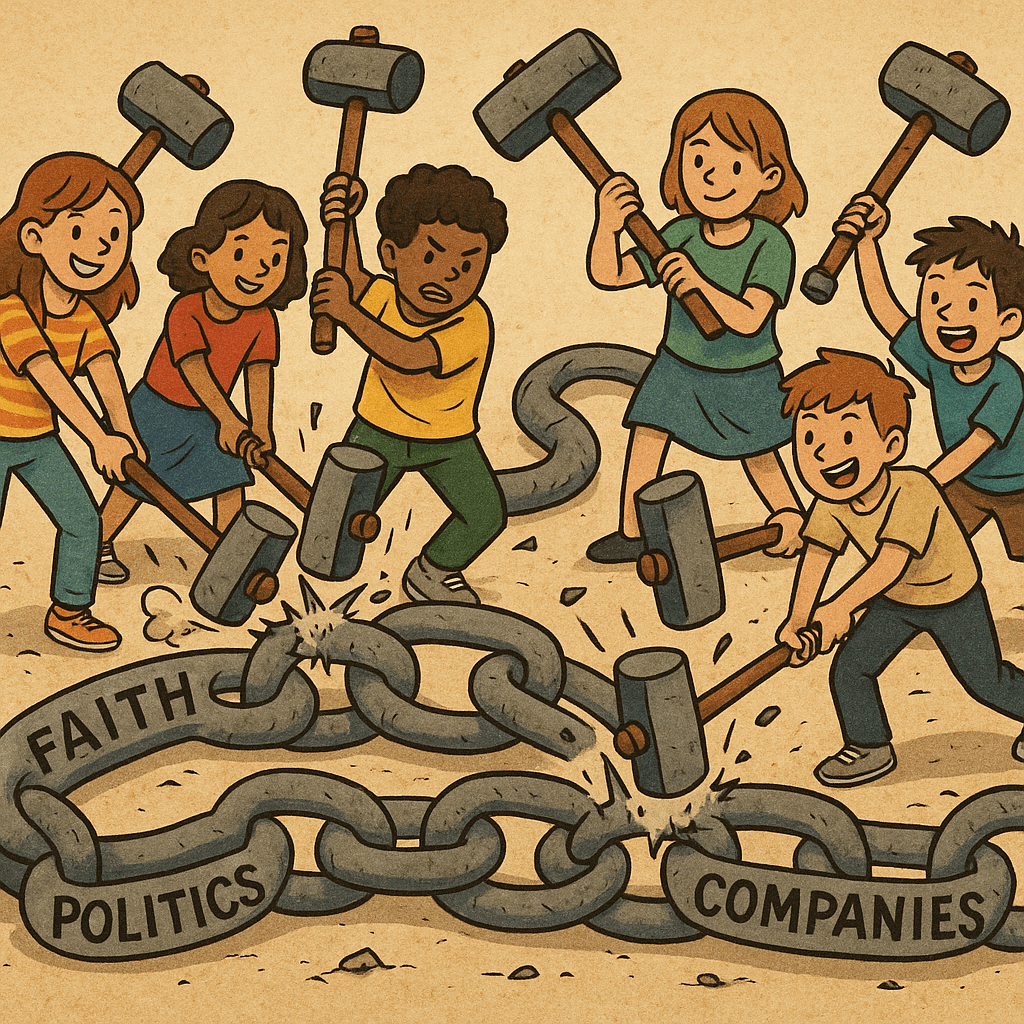
The ultimate irony: while some create AI to solve our problems, others embrace uselessness, retreating to safe spaces and artificial constructs – whether religions or professional politicians. We’ve automated solutions and built social structures that reward complacency over growth.
The greatest show on Earth continues. Will we watch from the sidelines, or take part in our own evolution?





 Douglas Schorr
Leave a comment