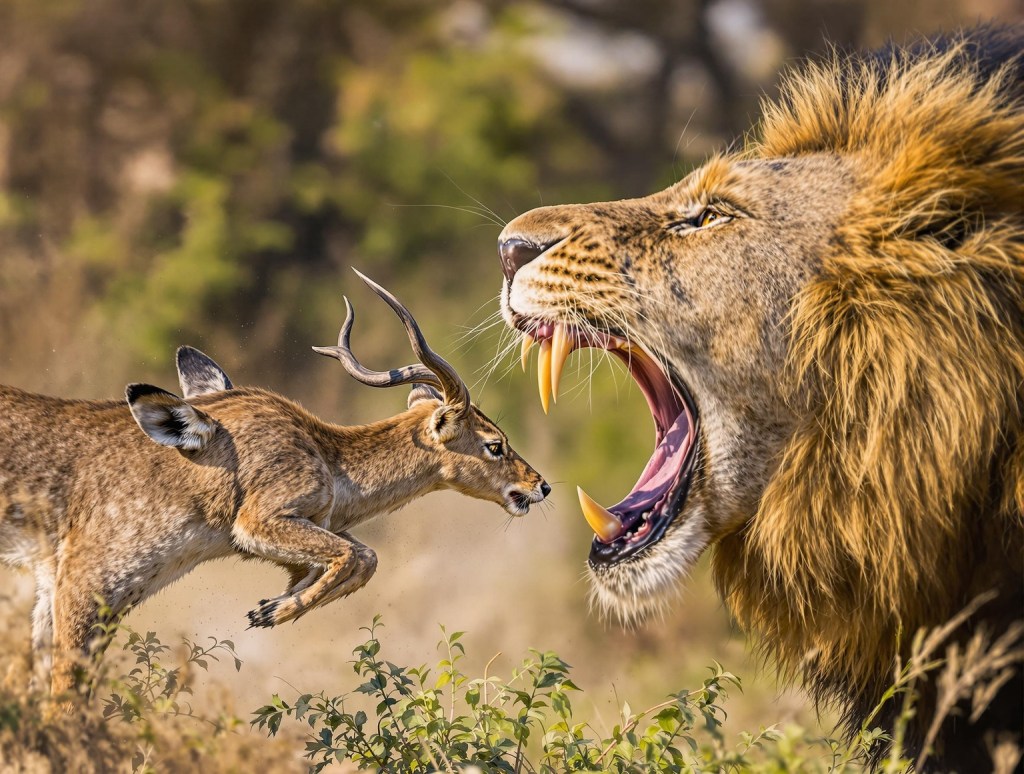
The next time you look into a wolf’s eyes or watch a dolphin hunt, remember: you’re witnessing the result of nature’s most profound cognitive arms race.
Through millions of years of evolution, predators developed larger, more complex brains to catch their dinner, while prey chose a path that signaled, “Escape,” escape!”—creating one of the most fundamental patterns in the architecture of animal minds.
Dr. Chen pulled up comparative data on specific brain-to-body mass ratios:
– Lions: 1/550 – Zebras: 1/800
– Tigers: 1/500 – Gazelles: 1/900
– Wolves: 1/350 – Deer: 1/1000
Even among smaller species:
– House cats: 1/100 – Rabbits: 1/750
– Fox: 1/250 – Guinea pig: 1/850″
Sara noticed something. “The predators consistently show larger ratios across size ranges.”
“Yes. And look at marine mammals:
– Dolphins (predator): 1/80 – Manatees (herbivore): 1/1000
– Orcas (predator): 1/200 – Baleen whales (filter feeders): 1/6000″
“The hunting requirement seems to be the key factor,” Sara observed. “Even when comparing similar body sizes or related species, the carnivores have significantly larger brains.”
“Exactly. The cognitive demands of hunting drove brain development in ways that the repetitive training of grazing, browsing, and filter-feeding did not.”
“Consider what a successful hunt requires,” Chen explained. “Each step demands complex cognitive processing:
1. Tracking
– Reading subtle signs: footprints, broken branches, scents
– Remembering territories and migration patterns
– Predicting prey movement based on terrain and time of day
2. Spatial Calculation
– Estimating prey speed and direction
– Computing intercept points
– Judging distances and jump trajectories
– Factoring in wind direction for scent concealment
3. Strategy
– Selecting optimal ambush points
– Planning escape route cutoffs
– Coordinating with pack members
– Adapting tactics when initial attempts fail
4. Kill Execution
– Targeting vital areas
– Timing the final sprint precisely
– Adjusting attack angles mid-chase
– Managing energy expenditure
Compare this to herbivores,” Chen continued. “Their primary tasks—locating vegetation, determining what’s edible, and watching for danger—while essential, require less cognitive complexity.”
“The predator’s brain must be a prediction machine,” Sara noted. “Constantly calculating possibilities.”
“The cognitive demands of hunting span all environments,” Chen explained. “In the oceans, predators face even more complex calculations:
Marine hunters must process:
– Three-dimensional pursuit paths
– Pressure and depth variables
– Complex current patterns
– Sound wave trajectories
– Bioluminescent signals
– Electromagnetic sensing
Look at the orca’s brain—processing sonar information, coordinating pod tactics, and tracking prey movements in three dimensions. Compare this to the Baleen whale, simply swimming through plankton blooms.”
“So what we’re really seeing,” Sara concluded, “is the result of an ancient evolutionary game. The rules were simple: solve complex hunting problems or don’t eat.”
Chen nodded. “Exactly. Whether in sea, land, or air, predators faced the same fundamental challenge—the need to out-think their prey. This ‘game’ drove brain evolution in one clear direction: bigger, more complex predator brains.”
“The prey’s strategy was different—invest in speed, strength, numbers, or armour rather than cognitive power. Their brains remained smaller because survival didn’t demand the same level of problem-solving ability.”
“Though,” Sara interjected, “elephants present a fascinating exception to this pattern. Despite being herbivores, they have remarkably large brains.”
“Ah yes,” Chen smiled. “Elephants break our simple predator-prey rule because they face unique cognitive challenges. A six-ton animal needs extraordinary amounts of food and water. Desert elephants, for instance, must remember the locations of seasonal water sources across vast territories and know exactly where to dig in dry riverbeds to access underground water. They’re not just grazing; they’re solving complex resource problems.”
“Plus,” Sara added, “unlike herd animals that can rely on collective knowledge—culture if you like—elephants depend on individual matriarchs to maintain crucial information about migration routes, food sources, and social relationships across decades. They’re essentially trading the ‘escape, escape!’ strategy for one that demands sophisticated environmental problem-solving.”
“It’s a pattern as old as the predator-prey relationship itself,” Chen finished. “The carnivorous predator-herbivore prey brain game played out across millions of years, leaving us this clear signature: the hunters evolved larger brains than the hunted—with a few remarkable exceptions where survival demanded different kinds of intelligence.”
Sara tapped her pencil thoughtfully. “Cognitive demands shaped these brains over millions of years. But what happens when those demands change dramatically? Our own species became apex predators through complex problem-solving and technological innovation. Now look at the data unfolding worldwide. In Africa (and the EU!) especially, more and more depend on social welfare, and the percentage of metabolically unhealthy populations is soaring. Humans have been pressurised to eat and behave like prey, and it is showing in health and cognitive declines.”
Chen’s expression grew serious. “Now that’s a provocative question for your PhD research. How will human evolution respond?”







 Douglas Schorr
Leave a comment