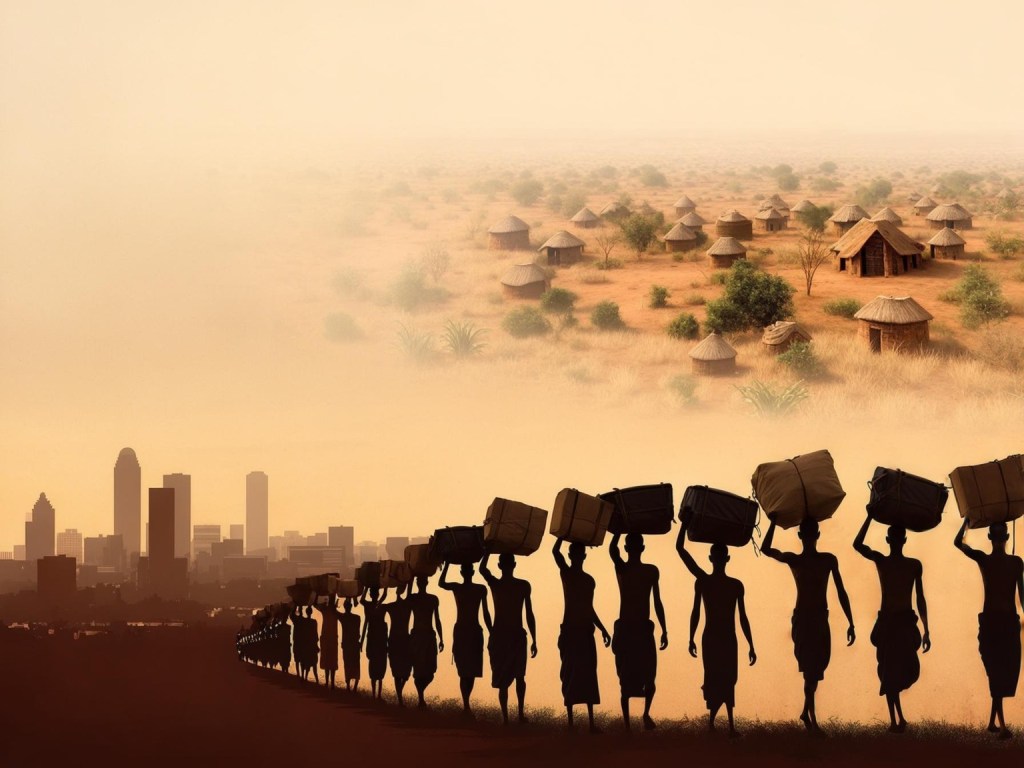
From tribal lands to urban sprawl, South Africa’s rapid urbanization highlighted a skills crisis that hangs large over the future. Will Malema train them?
Between 1850 and the granting of Union status in 1910, South Africa’s modern economy experienced a massive surge of urban development. As towns and villages complete with roads, water, and telegraphs, connecting schools, hospitals, and residential and business zones mushroomed in the corridors between the various tribes, a trickle of black South Africans “urbanized themselves” in either the English or Afrikaans camps. By 1920, estimates suggest between 10 and 15% had slipped the tribal yoke. For this story’s purposes, about a third but less than half aligned themselves with Afrikaner farmers, where they learned new skills but, more importantly, new ways of making individual decisions.
By the time America’s Great Depression arrived in the 30s, roughly 17% of blacks were urbanized. While developed SA was hit hard, given the hand-to-mouth agrarian lifestyle, it didn’t change much for blacks still in their tribal home places. With WWII’s clouds gathering, General Smuts called on the people to support war industries. Whereas nearly all growth to date had been spillover from mining activities (which aren’t covered here), South Africa was set to industrialize. The first wave of job seekers came mostly from the failing farms, bringing their new skills and new ways of thinking. Welcomed in the new factories, those assessed as suitable were immediately put into job skills training programs. The Smuts’ initiative saw black urbanization jump from 17% in the 1930s to 28% by the time the fanatical “God wants us separate” Malan government took over.
So it was that only 75 years ago, over 70% of black South Africans, segregated by culture and custom differences and by hundreds of years of suspicion of each other, still lived on the same lands their immediate ancestors had recently claimed. The winter rainfall zone of the Western Cape was the exception. This had become home to the few and scattered San and Khoi whom the Bantu had pushed south since crossing the Limpopo not long before. Now they faced white Africans coming from the sea.
From 1950 to 1980, black South African urbanization accelerated as people became interested in what the growing cities and towns offered. Compared to what they had, it was substantial—acceptable accommodation, schools, clinics, integrated shopping, and recreation areas.
These folk made the deliberate choice to give up the known to step out on an untraveled road, to become something different. By 1980, black African urbanization had reached around 45%. While 28% to 45% falls short of doubling, what the vocal do-gooders and ultra-liberals shouting from London cocktail parties failed to mention was that these percentages represented vastly different population bases. For many white African-initiated reasons, the population had again exploded. The 28% of 1950 accounted for less than 4 million, while the 45% of 1980 meant providing for 13.5 million. Still doable.
What proved undoable was the black politicians’ response during the buildup to majority rule elections. With funds pouring in from international church groups, keen colonialism disruptors, do-gooders, and ultra-liberals, they bused in many thousands to change voter demographics. Overnight, squatter camps mushroomed—today’s massive Khayelitsha City outside Cape Town grew from one such seed. There were no facilities and, above all, no jobs. Even more demeaning and damaging for the long term, unlike all the urbanized of the past, these people hadn’t made the decision consciously or by themselves. They arrived without any skills to compete in a modern economy or intellectual tools to problem solve. Armed only with old-world skills, they were left to compete for limited resources with their new neighbours.
By 2000, roughly 60% of black South Africans—over 28 million—were urbanized.
The black nationalist parties’ election promise was to fix what white administrators had left undone. The point isn’t that the ANC failed—that was obvious to everyone except the senior UCT lecturer who marked my last paper “rubbish” and stole my 75% aggregate pass mark—but that the new government refused to recognize the magnitude of the skills deficit going forward. As you’ll read later, Mbeki, the theorist who should have known better, introduced the SA-killing BEE initiative, somehow reasoning that reduced pass marks would suffice.
Reality is SANNA is required to take in the millions becoming mothers and fathers who desperately need training to reinvent themselves.






 Douglas Schorr
Leave a comment