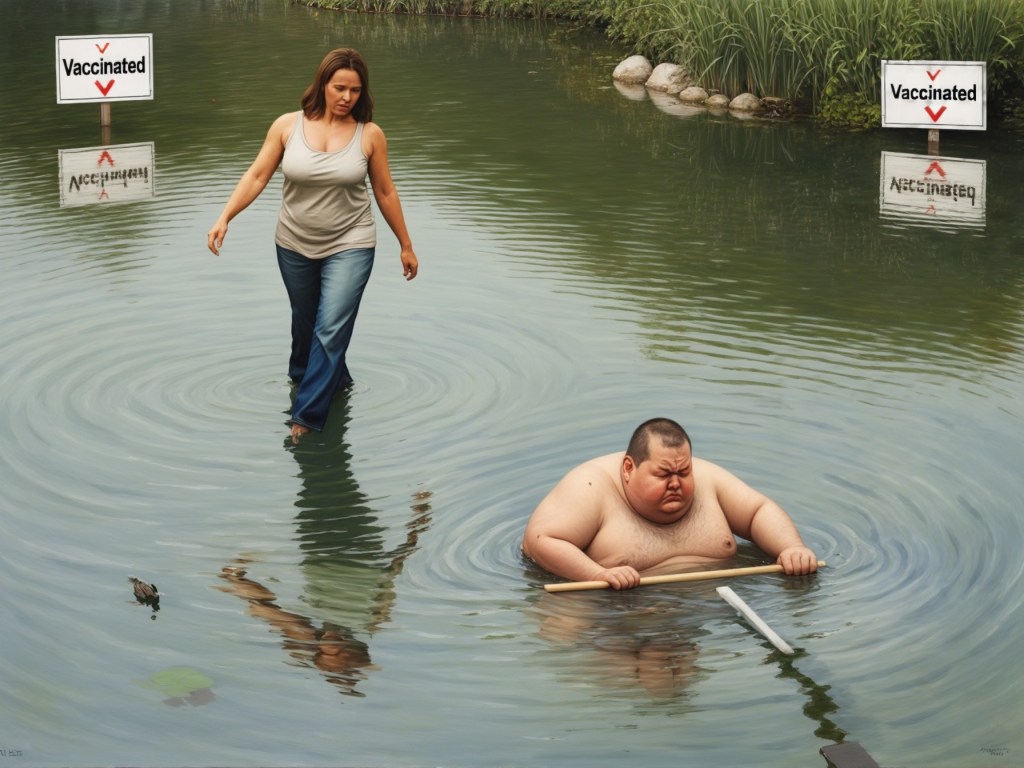
Chronically ill? That ‘preventative’ shot maybe isn’t for you. It’s for the healthy to walk on water.
Six Pence, the circus clown, teetered on the high wire at the Boswell Wilkies Circus in, Bulawayo, Southern Rhodesia. My sister and I buried our heads in our mother’s lap, screaming, “Mom, he’s going to fall and kill himself!” He did fall, but unlike most real-life falls, he landed with a flourish and a smile, leaving us laughing instead of crying.
That memory stayed with me because it captured something fundamental about life—we all walk our own high wires, balancing precariously until we reach our tipping point. Unlike Nassim Taleb’s Black Swan Events that hit as the meteorite came for the dinosaurs, tipping points are entirely predictable. We can see them coming at school, at work, in our marriages, the friends we accept “because,” on the credit card bill, going to a funeral, and saying, “I should have phoned.” Mostly, for a multitude of reasons, we choose to ignore them or design elaborate, highly compelling excuses.
My own high-wire act lasted decades. At 18, I started drinking to mask anxiety and confidence issues. I tried to balance the damage by staying physically fit and following doctors’ orders. Around 33, believing I was making a healthy choice, I switched from Mom’s meat-based diet to one heavy on carbohydrates, fruits, and loads of green vegetables. That decision, I now realize, was edging me closer to, “Jump!”
The message finally came while I sat in the bath, confused by all the blood. I was wondering from where was bleeding. I was trying to make sense of it. I was getting nowhere. I was lost in confusion. I was about to ignore it—like I had ignored so many warnings before. I was jolted when my brain issued its ultimatum: “Mind and me, and all the guys and girls down below, have decided. Either stop acting like an asshole or we’re out of here.” Each “I” had been a step closer to the edge, each representing another layer of self-deception until my body finally broke through and explained I wasn’t in charge—it was.
Vaccines have been one of medicine’s greatest achievements, especially critical since global travel exposed populations to new pathogens before they could develop natural immunity. They served as elegant training programs for our immune systems and worked brilliantly in metabolically healthy humans, creating robust herd immunity while reducing the need for microbiome-destroying antibiotics. We trusted vaccines because we remembered grandma’s horror stories of the Spanish Flu and witnessed polio’s devastation.
But across the developed world, particularly in America—simply because they were first to have pots of money to waste—we’ve created a metabolic health disaster. The human body wasn’t designed for the processed foods we’ve been consuming for generations. The longer this experiment has run, the worse the results have become. What were once adult-onset diseases now appear in children. What were once seldom heard of genetic disorders are discussed at the office tea break and social BBQs as everyday stuff—”Oh yeah, my boy is ADHD too. What pharmacy do you donate to?”
As our processed diets and damaged microbiomes weakened our metabolic health, vaccine efficacy declined. The cruel irony is that even Americans who try to stay healthy face an uphill battle. Over the few years, doctors and allied others seriously concerned about our health are saying over 90% are metabolically compromised—their bodies struggling to handle even minor health challenges. They’re all walking Six Pence’s high wire, but without his safety net. When their tipping point comes—whether through illness, stress, or medical intervention—they don’t bounce back smiling. It’s as though there is nothing in reserve.
We’re seeing this play out in the aftermath of the pandemic. Unlike my fortuitous experience, many found they had no choice. Standing on Six Pence’s wire, they followed government orders—the orders of governments that might well understand viruses but seemed blind to the state of general health. For many, it was like performing surgery on an already failing heart.
Is it possible that the mRNA vaccines became the final push for many already standing at their metabolic edge? The obese, the respiratory-compromised, those with chronic inflammation, diabetes, and particularly those with the added complication of old age, perhaps should never have received an intervention of unknown consequences—their bodies were already fighting a daily battle. The crucial question went unasked: had these new-age vaccines been tested on those who were fundamentally already sick?
It is common knowledge now that 99.9% of people who got Covid and were fit and healthy mostly handled it as they would a bad cold. But for the compromised, this new intervention wasn’t just another challenge; it possibly was the tipping point their bodies couldn’t survive. Hospital coding protocols and reimbursement structures encouraged marking deaths as Covid-related. Post-pandemic, the deaths continued. The obituaries called these deaths “unexpected” or “sudden,” but maybe they were neither. Like me trying to bathe in a bathtub of blood, they were messages written in bold, telling us that we can’t keep ignoring what our bodies have been trying to say.
Few get the warning I received. Fewer still heed it. But perhaps by understanding how our choices accumulate—each “I will start tomorrow” and each “just this once”—we” might recognize our own tipping points before they recognize us. And if you are sick, maybe avoid doing what healthy, fit people do!





 Douglas Schorr
Leave a comment