How Earth’s greatest climate catastrophe gave humanity its luckiest break. Please gods, do it again.
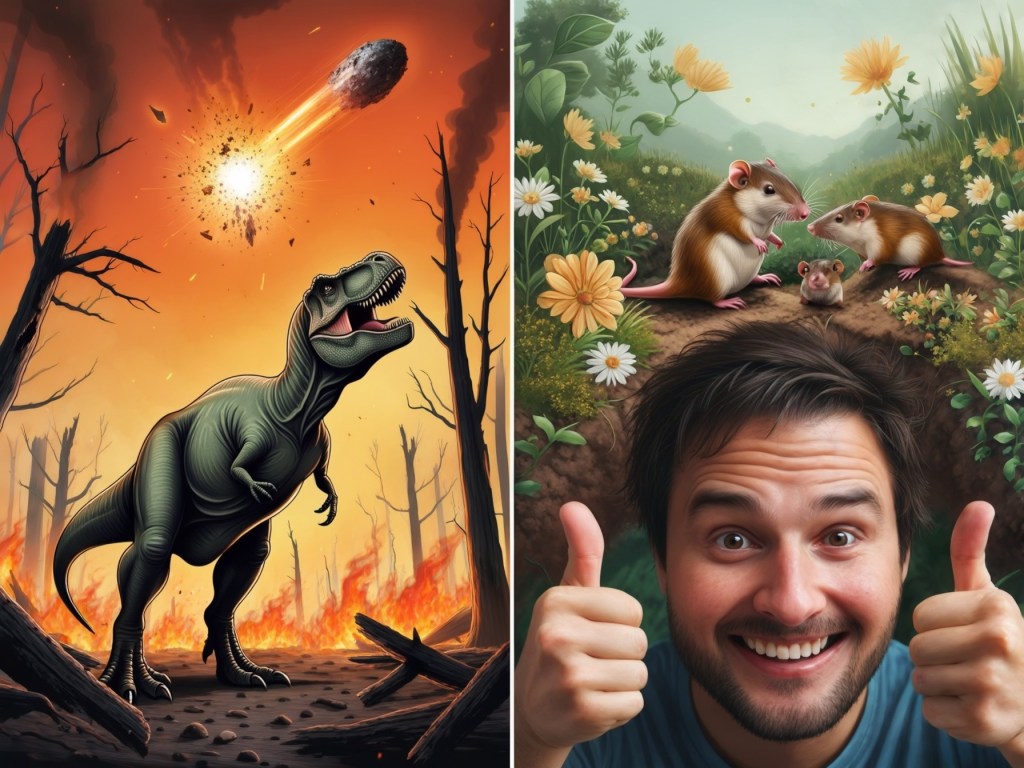
That was the day climate chaos blew open the door for humans, unwittingly making us the eventual kings.
It was the more advanced of the dinosaurs—not humans—that were on track to be the ones building spaceships. They had been the supreme rulers for 140 million years! The few big, but mostly medium and small dinosaurs, unlike other reptiles of the time, were warm-blooded and evolutionarily advanced, sitting atop the food chain. The conditions so suited them that nothing could stop them from developing superior intelligence. Lucky for us, they died—in cosmic terms—suddenly.
Approximately 66 million years ago, a 10-kilometer-wide asteroid cratered the Yucatan Peninsula, Mexico, ejecting debris worldwide—pollution, dangerously poor air quality we call it today—and generating shockwaves, firestorms, and tsunamis. This event coincided with major geological changes: North America was pushing up the Rockies, South America was pushing up the Andes after breaking from Gondwana, the Antarctic was edging south, Australia east, and India, spewing huge amounts of lava that lasted millions of years, was drifting north after separating from Madagascar.
The incredible luck of an asteroid collision and the aerial muck generated, continent shifts, new oceans with new current patterns, and new mountain ranges influencing winds and the 2nd biggest ever series of volcanic eruptions happening almost simultaneously (in cosmic terms) opened an ecological niche for mammals to literally come out into the sunlight.
As the fundamental power on Earth, the Plant Kingdom determined what happened next. Through photosynthesis and oxygen production, plants control animal life on Earth, and we are animals. The smart ones.
The dinosaurs were gone, and the climate changed in favour of life: the earth’s long march to getting colder was, albeit temporarily, suspended. Approximately 2-3 million years later, except for the poles, Earth was nearly ice-free. During the following 12 million years, at the Eocene Thermal Maximum, global temperatures soared to perhaps around 16°C higher than today, with atmospheric carbon dioxide levels possibly reaching 4000 parts per million. Is there any better explanation for a nearly ice-free world of supporting thriving green polar regions? Would you have guessed our scientists have found fossil evidence of early camels roaming what is now the North Pole region?
In this perpetual spring-like climate, mammals grew much bigger than found today, and thrived in the verdant, woven forests that rooted in good soil. For the first time, flowers appeared. Plants in competition for clients offered new niches and dimensions—demonstrating nature’s evolutionary creativity and the interconnectedness of all beings. Suddenly the Earth could be described variously as a Snake Planet, an Alga Planet, a Grass Planet, a Plankton, Bacterium, and Virus Planet. Bathing in much warmer, rich oceans, it was the golden age of Coral Reefs, and on land of Big Cats, and in the soil, of Nematodes, and much more. For us, “Ape Planet” was real!
Not ‘us’ exactly: as plants flourished as never before, so too was there an explosion in diversity and richness in the Animal Kingdom—the oxygen breathers! Though we were just another animal group fighting for a place, our distant shrew-like ancestors became our ape-like ancestors. Within a few million years, they evolved as tree-dwelling primates—labeled “Wood Apes”—and, in many shapes and sizes spread across the CO2-gulping forests of temperate Eurasia, enjoying many millions of years of evolutionary development.
The killing cold resumed
These early primates experienced an unprecedented population boom, but sadly it was short-lived: the warmth had been brief, and the greenhouse climate was, in geological time, fading fast. As the Earth again cooled, oxygen-producing plants became less efficient and shrank, leading to a cycle of a drop in oxygen (O2) production and CO2 levels. The life-filled forests and oceans that had edged both the Arctic and Antarctic disappeared under ice, and deserts like the Sahara, Gobi, and the Australian Outback appeared. As the ice crept south, the living space and consequently the numbers of primates dwindled. The survivors—New Age Monkeys in South America, monkeys, orangutans, and gibbons in Southeast Asia, and monkeys, gorillas, chimpanzees, bonobos, and early humans in Africa—found refuge in the equatorial regions. While the rest of the Earth has seasons, the equator is the world’s average. It is hotter, most humid, experiences optimum growth, produces the most free O2, and takes in the most CO2.
The cold persisted, transforming flourishing jungle into savannah and limiting the great apes of Africa to strips of jungle along the equator. The impact of this cooling was dramatic—the Eurasian brown bear, once a far northern species, faced advancing glaciers only three to four million years ago, eventually giving rise to the polar bear. While many primates like baboons and vervets adapted to life in grasslands and mountainous areas, this cooling narrowed primate diversity, focusing our evolutionary path.
We were awfully lucky that the dinosaurs were wiped out and that the causes of their demise became our building blocks. And though many did not and are not here to tell, we are lucky that the new us, the primates we became, had enough sense to run ahead of the cold and kept our feet warm.





 Douglas Schorr
Leave a comment