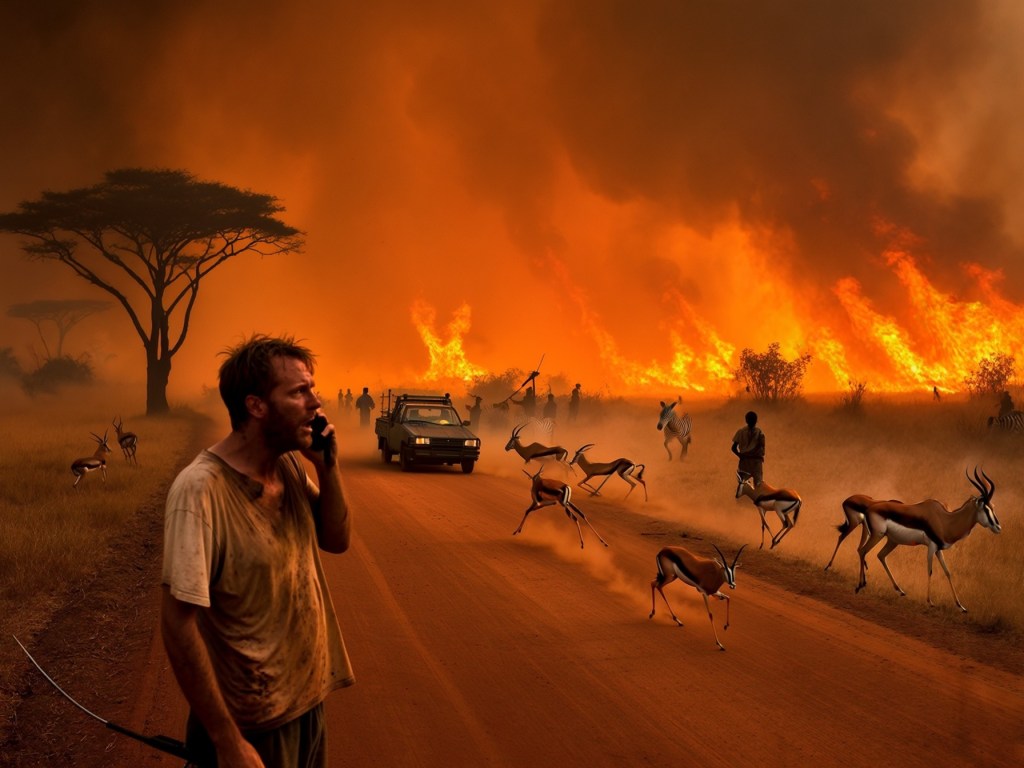
When throwing money and ideology at forest fires fails, try a little practical management wisdom.
In 1960s and 70s Rhodesia (now Zimbabwe) managed wildfires on a shoestring budget. Our small nation, primarily agricultural, lived and died by the land’s health.
Except for a few spots along the Eastern Border, our landscape was never tropical green but more mellow-yellowish. As rainless months dragged on, this subtle green would crisp and fade, leaving grass brown and trees limp. Everyone was on fire alert until the rains finally stormed in—bringing both celebration and concern. While people danced in the downpour, most non-city adults knew that too much rain too fast spelled disaster for our precious topsoil. Inevitably, with frightening thunder and lightning, that’s exactly what would happen.
Our solution started with a handful of land management experts who built a chain of knowledge—experts trained assistants, who trained supervisors, who led teams of workers. In good years, when harvests were strong and money was available, we employed more workers, strengthening land management against the cyclical climate patterns we knew would come.
These teams, our ever-vigilant front line, served dual purposes: restoring eroded lands and preventing fires. Through backbreaking labour (even tractors were a luxury), they collected dead wood and cleared flammable undergrowth, strategically placing the material to slow water flow during downpours. There was the counterargument that where debris is left to decompose naturally, it feeds the soil. But unlike much of the tropics and the Northern Hemisphere, what was typical for us was “dry and crisp, ready for a spark” vegetation. We knew the risk of fuel buildup was too great—we would feed the soil in other ways, primarily by rotating our animals to do it naturally.
And, in a separate exercise, using a different team, every farmer’s field was inspected to ensure he/she had constructed contour ditches—like speed bumps for water—preventing erosion from cascading downhill.
Those teams focused on fires went beyond removing dead wood. They divided vast stretches of land into manageable sections using firebreaks—still massive chunks of land by European standards, but controllable. Keeping these firebreaks clean became a matter of pride and responsibility. Some districts assigned individual caretakers who spent their careers maintaining “their” sections, keeping them free of leaves and sprouting scrub that could act like stepping stones for fire to cross.
In our small, interconnected country, everyone understood how vital our vegetation was to survival. While today’s budgets often prioritize crazy social initiatives over environmental management, back then our focus was necessarily practical. When fires broke out, the community response was immediate and universal—even rugby and cricket would stop! You’d see modest trucks pulled over on the “strip and dirt” roads we proudly called “trunk roads,” farmers, townspeople, and tribal communities all pitching in with whatever they had. I carried a recycled maize bag which I’d soak (we all carried water in our vehicles)—one swing, one flame dead. Though I later learned that scorched lungs and COPD don’t mix well, back then you just did what needed doing.
This wasn’t just about fighting fires—it was about understanding our place in nature’s cycle. Unlike today’s headlines of unstoppable infernos, we knew that managing the land meant working with it year-round, not just reacting when flames appeared on the horizon. Everyone from the smallest landowner to the largest commercial farmer recognized that their success depended on their neighbour’s well-being and the health of the wider ecosystem.
Looking at modern wildfire management and the associated professional politics, I wonder if our limited resources forced us to develop deeper wisdom. When you can’t throw money at a problem, you must apply the lessons of history instead. You learn to work with what you have: human knowledge, dedication, and the understanding that in matters of nature, we’re all in this together. The question we should be asking isn’t how much we can spend but how best we can work with Mother Earth.




 Douglas Schorr
Leave a comment