
Making Early Humans: A tale of survival, innovation, and unprecedented intellectual advancement.
Way back then, Africa ranked top in every “Freedom Want” imaginable. Say and do what you want, eat and drink was your choice alone. Enjoy the tickle as you ran naked through the grass. It was a grand romp in a place of wonderfully explosive dawns that lit up our eyes and beautiful fading sunsets that reminded us to sleep. In between, long, extraordinarily hot and humid days to roam the pristine jungle or the encroaching savannah. No taxes, no government, but dang, Africa was dangerous. On average, folk were lucky to see 21.
Back then a safe space wasn’t a counsellor’s office—it was you, breathing heavily, looking down to make sure whatever had attacked was dead.
Imagine being a kid looking down from the giant thorn tree you’d been hidden in, watching the annoyed elephant with a spear in its side trampling Mum, Dad, and Uncle. You had to know what to do once it had decided its place was safe and wandered off. Imagine peeking out at your family being butchered. Now the other group is deciding who to assimilate. We knew to do what today so many pompously decry as wrong for good “Us and Them” reasons. You would not be here if they hadn’t.
The logic of our behaviour stemmed solely from fostering humanity through functioning hierarchies practicing original economy: constantly improving ourselves to build stronger, more inclusive relationships to lift our group. “Our” doesn’t include lions and snakes, or other “Them” who look like us but eye our Jimmy’s broad frame and our Sue’s wide hips with dangerous intent. We know they know she can increase the group’s numbers by 5% a year! Make them run!
Running? Us? In Africa, we transformed from ape to human, our bodies changing dramatically. We learned to sprint and trot for hours, climb sheer rock, crawl underground passages and in the grass, stand tall with sticks on our heads making us look bigger, and swim. Of course, the biggest thing that happened to us alone was the growing ability to make conscious, rather than instinctive, decisions.
The continual, always frightening Us and Them encounters taught us to differentiate. Though still with a child-brain, we came to appreciate that the ability to discriminate sensibly is precious. Indeed, to be incapable of differentiating was incalculably costly.
Roughly 1.5 million years ago, as our competencies advanced, early hominins began utilizing caves for shelter, moving away from open living spaces. In evolutionary time, that was quick; remember we had spent tens of millions of years making nests in trees before setting foot on the ground. Mostly we used rock overhangs and caves as homes. Though it remains in our armoury of can-do, scavenging too was a past skill. The more competent hunters brought home fresh meat.
“More competent?” Yep, a long time ago we began to notice growing differences in the performance of graduates of Headmistress Eve’s schools. It had to be: striving for humanity through the principles of economy lifts individual performance but not equally. It drives getting better leaders at every level in the hierarchies. The skull is connected to the neck bone, the neck bone to the chopping block, unless you realised everything is—as Adam is to Eve—inseparable yet fiercely independent, and being so, it was up to each and all to perform better today than yesterday.
The more competent women organised better home bases, and we explored our local area more and harvested wild animals better. We were getting bigger and stronger on our dense, ketone-producing diet, getting taller and better proportioned for bipedalism. Women were better able to deliver babies, and our numbers grew. Compared to a million years before, we became a crowd. With that unruliness, our “what if” thinking abilities grew because we fed our bigger brain with meat, fat, and problems—we were getting smarter—a chain reaction. We started making tools. Put that all together, and if you went back in a time machine, you would see we’d gone back into the open-building huts!
What Headmistress Eve had started had expanded. Home bases became our first technical schools. Young ones gathered around the skilled, watched hunters prepare, observed how disputes were settled and listened to Mum. These weren’t random lessons but the foundations of our culture, passed down and refined through generations.
More than just shelters, these bases evolved into our first universities—places where we had time to think. Resting, digesting a grand meal, we’d swap thoughts. Those meals weren’t daily events; not every hunt ended in a kill, but when it did, we did feast, and in that satisfaction came contemplation. Someone would notice how stones broke differently when struck in certain ways or how a well-selected stone used bluntly could open the wildebeest skull. Another discovered the binding mothers made good bindings for spears too. These weren’t just random discoveries—they were shared, refined, and taught to others.
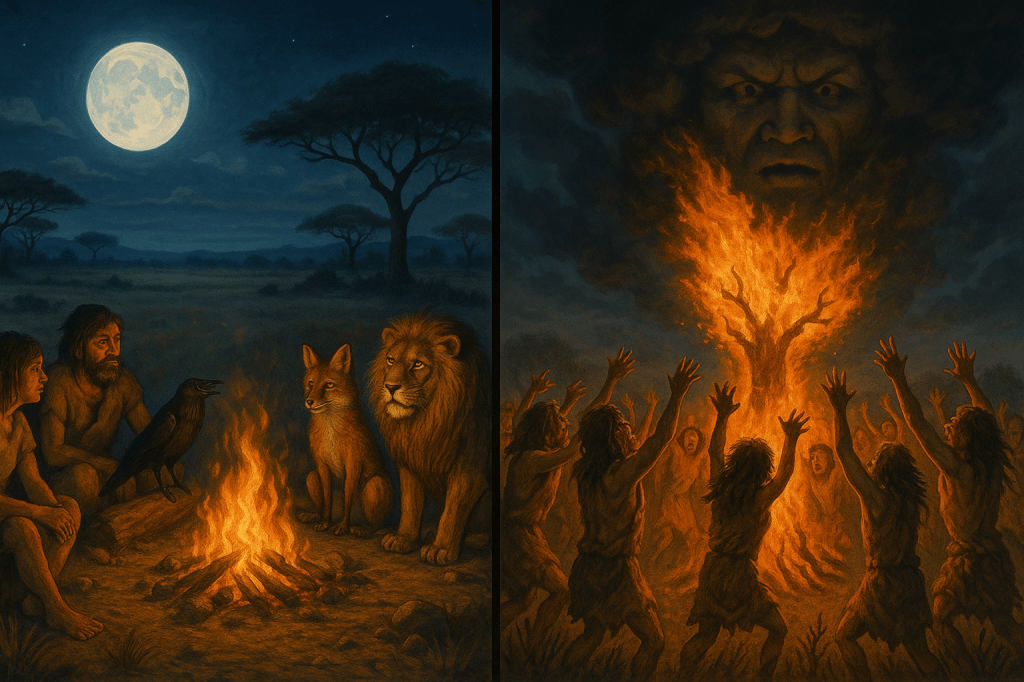
Though we continued to use special caves for religious get-togethers, the rude huts we constructed simulated those commonly lived in in Sub-Saharan Africa today. In both the gods-praising caves and the sheltering huts, we were at once, all together yet separate, according to our hierarchical relationships. Beside them, in the healthy open air, we built controlled fires, and we cooked!
We had successfully pioneered Humanity… for Us. At last, after millions of years of struggle, we lived the idyllic life. Mostly we knew what to watch for in the environment and weather, and other animals mostly left us alone. Meat and fat, eggs in season, water and salt, a place to keep out of the intense heat, good company, and noisy children—what more could one want?
Well, hmm. With every unit having a hut, and then every sub-unit having a hut, the organisation and logistics of living in groups of size presented problems beyond us.
“Listen,” grunted Dad to Tinkling Water and Autumn Flower, “why don’t you and a few others disappear over that hill?”




 Douglas Schorr
Leave a comment