
By organising differently from others, humans unknowingly triggered an evolutionary revolution. Their secret: independent, interlocking, expandable hierarchies.
When we left the trees, all the other animals laughed and danced like baby baboons. With our misaligned hips, gangly arms, clawless hands, and brains barely larger than today’s chimpanzees, we stumbled forward on puny legs. Yet even then, determined to develop our predator side, we set out to prove them wrong.
Our leap beyond other animals came from recognizing how to better use the Trinity’s gift of the basic hierarchical system. It wasn’t a special privilege given learner humans -every living group had its own and participated in many cooperating hierarchies. Our advance was dramatic though by today’s hurry-up culture it was pedestrian, certainly an incremental game of waiting on small improvements.
Think of the Trinity, our brains, minds, and skill sets as interlocked cogs driving our whole. Unlike other animals, we developed unique attitudes toward economy—planning ahead, storing resources, sharing fairly. Like male and female—separate yet inseparable—each cog had its role but couldn’t function alone. When the environment triggered Cog A, it needed B to move C and G, but D and F had to first shift G to move C, and together they advanced A. Our “machine” required perfect mesh. And we meshed!
As told in “Once We Needed Gods,” our determination to solve the insurmountable led to larger brains and connecting minds. We continued down that road-never-before-travelled.
Human hierarchies are simple: Mum and Dad have 4 children—two boys and two girls. Luckily these girls livelong enough to have a child or two of their own, and the boys prove to be proficient protectors and providers. Now we have Leader Mum and Leader Dad—the structure has added a level. In time it will add another.
One of our first innovations was recognizing the “elder” rank. While standard baboon troops—our heritage—only recognized babies, adolescents, and competing adults, we saw something more. “Elder” meant authority through experience—been there, done that. Though luck played its part, longevity proved superior problem-solving abilities. As our hierarchies grew and Dad became Leader Dad with junior Dads below, elders moved up the ranks, staying alive in deadly times. These grandparents became our first “task force,” running an advisory consultancy within the family/tribe’s command chain while being outside of it.
Under Leader Dad, reporting relationships flourished. Leader Mom might report to Leader Dad on some matters yet serve as his sounding board on others while heading her own hierarchy, mentoring all mothers. These mothers didn’t just run their homes—they held responsibilities across hierarchical structures, liaising with guards and hunters while respecting rank within Leader Dad’s overall structure. Complex, yes, but natural—ordering chaos was our way.
We elevated the junior-senior dynamic. Beyond simple copying and instruction, we added imagination—the ability to think “what if.” Humans didn’t just follow innate instructions tweaked over eons; we made changes within lifetimes. Young minds brought fresh thinking, passing it to new juniors. Our manual of dos and don’ts expanded, becoming a vital tool for maintaining order as our hierarchies grew more complex. These shared rules helped coordinate actions between different groups and levels of authority, making our growing social structures more stable and predictable.
There was no grand announcement when our generalist life evolved. Those who feared “killing jobs” watched amazed as the notion of the division of labour—Eve’s momentous brainwave—created specialized roles and new careers. As Leader Mom’s community grew more complex, the pressure for better provisioning and protection drove us toward specialization. Like Eve splitting herself to create Adam, we split tasks to become more effective. Hunters became expert trackers, spearmen, skinners, and butchers. Guards developed into sentries, reaction men, and warriors, and when we were on the move, perhaps we had scouts.
This professionalization, born from dividing labour into specialized roles, triggered that eternal cycle found only in humans to any great depth: imagination spurring skill development, leading to better practices, sparking more “what ifs.” As detailed in “When Necessity Mothered Humanity,” each individual’s commitment to excellence—to being better today than yesterday—strengthened the entire group. Through cooperation and specialized expertise, we built ever-stronger relationships that lifted everyone. Each person’s increased productivity raised the hierarchy’s capabilities, making the whole greater than the sum of its parts.
As our groups grew, managing communication became crucial. With just four members, twelve possible communication channels existed—each person potentially talking to three others. Add just two more people, and the channels jumped to thirty! When families expanded to three levels and thirty members, the potential channels became overwhelming—over 400 possible connections! Consider a hunter needing to coordinate with guards about a predator threat: without hierarchy, he’d need to alert each guard individually. Our solution was elegant: each hierarchy within Big Leader Dad’s overall structure developed its own leader who would handle communication with other hierarchies. The hunters’ chief spoke with the guards’ captain, who reported to Leader Dad. The gatherers’ head coordinated with the hunters’ and guards’ chief and compound Leader Mom. A sentry spotting danger would tell his captain, who’d inform both the hunters’ chief and Leader Dad—three focused communications instead of dozens of scattered warnings. This streamlined structure—hierarchies communicating through their leaders—brought order to what could have been chaos, making our growing communities more effective and efficient.
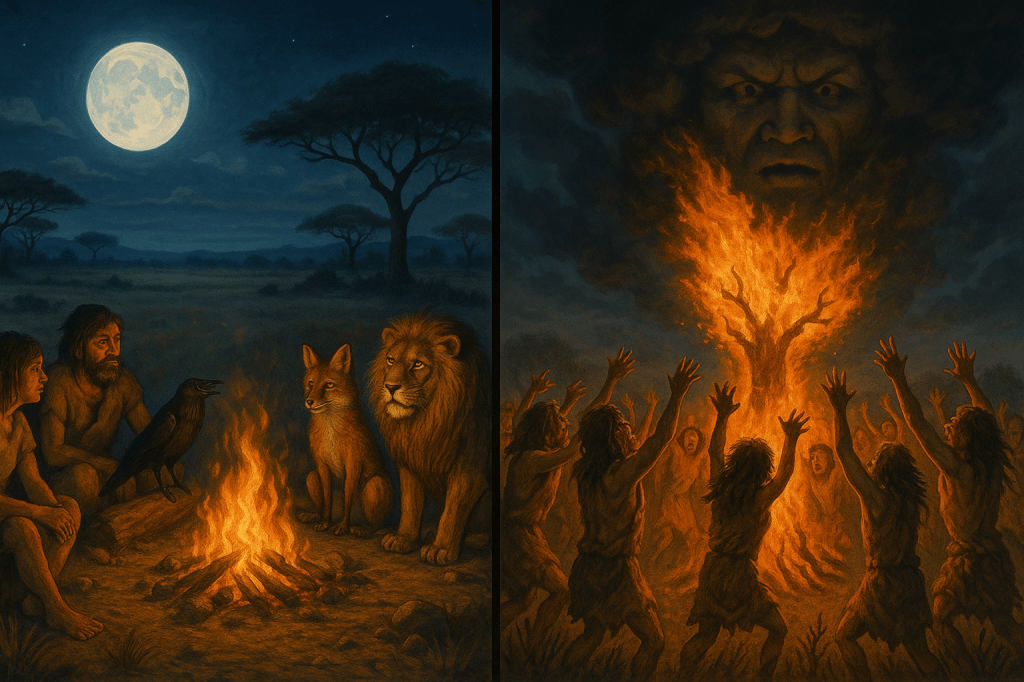
By today’s measures we were still apes, but way ahead of those who laughed and played the baboon as we passed by. We were a completely different sort of animal. As Leader Dad told the Time Machine operator, “I mean, doing the same old thing hasn’t done much for Lion, eh? By developing our institutions, we’ll soon be the kings around here!”
It was only the beginning. I will enjoy writing, “And then Eve started a school.”



 Douglas Schorr
Leave a comment