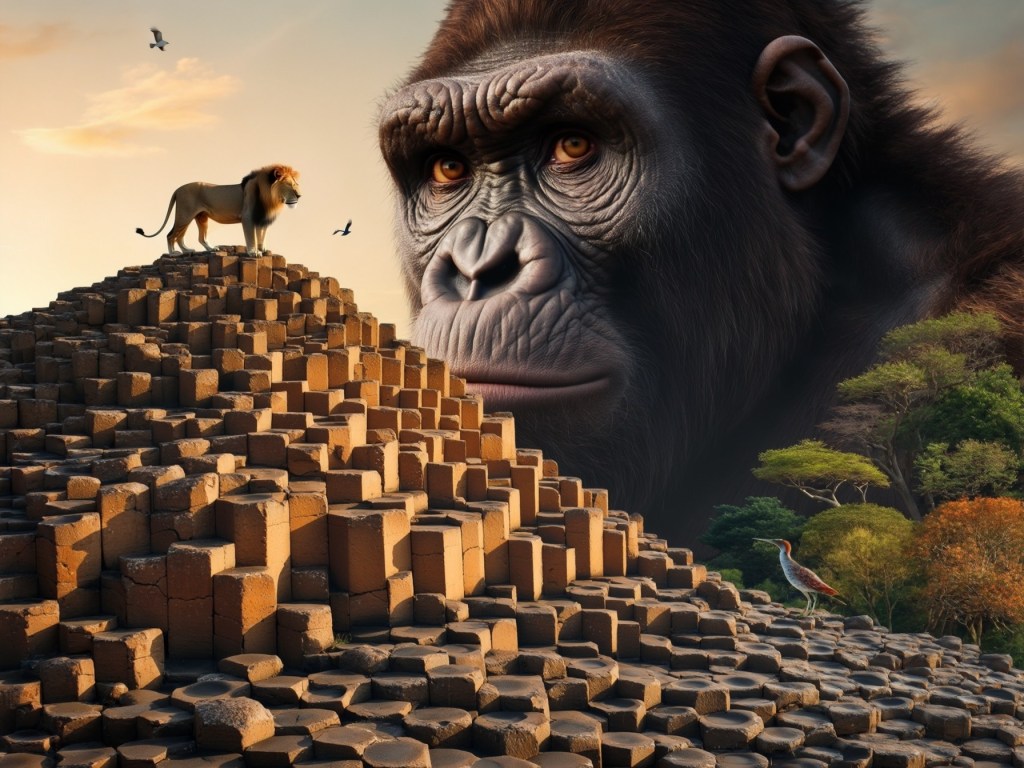
Hierarchies weren’t invented—they evolved over billions of years as the only way life could thrive. From the first Eve to modern humans, ordered competition created everything we see around us.
When THE Lion roars, all pay attention. All creatures are keen listeners, particularly males. The Trinity charged them to forever protect and provide. “Is the Lion (or any other of a long list of competitors) announcing a threat or signalling that it’s safe to relax?” The senior male’s interpretation determines the orders given the group.
This apparent male dominance at the top of life’s ladder is a misconception, shaped by religious narratives woven into society over time. Regular readers recall in the introductory “In the Beginning” stories that the true origins lie with Eve—the first living cell. For billions of years, microscopic Eves carried life’s burdens alone, guided by the Trinity’s blunt message: “Survive or disappear.” And imprinted on her soul the crucial 4 Ps: produce, parent, provide, and protect. For the continuation of her life, she had to compete better than enough of the others for the same resources. Doing all simultaneously proved impossible, so Eve learned to prioritize. By discriminating using “why, what, when, where, and how, “she established the universe’s first hierarchy of needs.
Still trillions of Eves perished before maturity. The Trinity and Eve’s brainwave was the ‘division of labour.’ Each Eve split into an inseparable pair. She retained the primary duty to produce and parent, and the new Adams took on the service roles of protection and provisioning. This marked the inception of the world’s first living hierarchy.
Fast forward a couple billion years: the Earth blossomed with recognizable animals. We see males, mostly, taking charge—bossy and blunt perhaps, but they are fulfilling their Trinity-assigned responsibilities. Societies whose males perform flourish. Advocates of cancel culture best remember we are animals. That said, the greater the Eve-Adam cooperation, the greater the chance of success.
Not all life chose the male/female split, but those that did developed intricate hierarchies within their social structures. Even seemingly simple organisms, like insects and shellfish, exhibit hierarchical behavior. Plants, too, partake in this complex dance, although their exact roles remain somewhat mysterious. Hierarchies are about leadership at multiple levels, with every member in service to one another. As detailed in the post on “Economy,” it is the simplicity that is astounding. Nature’s grand economic objectives were to ensure safety, access to food and water, resting places, and the continuation of the group through successful breeding. Each member’s improving contribution is essential. Only fully functioning—supportive—hierarchies achieve this.
What exactly is a hierarchy? It is an ordered arrangement, best illustrated by a pyramid. Many juniors form the broad base, and fewer and fewer seniors make up the higher levels until, at the top, there is just the most senior of all.
How does it work? All members are born in possession of (specie-specific) a “winner’s manual of behavior” coded into their very essence. Depending on circumstance and location, each group interprets how best to perform the 4 Ps. Armed with this basic culture—developed over tens of millions of years—each newborn begins its unique journey. Starting at the bottom of the hierarchy, it converts instinct into practical application as it learns from those above them. Cheetah cubs learn to hide, be aggressive if found, and later to hunt. Impala calves are also taught to hide but if discovered, to run and dodge. And later they learn what they can eat. For baboons, junior school is about playing to develop essential skills. This learning never stops for the winners. It just gets more serious; seniors add to their productive role, being teachers of the next generation. On our forever changing planet, millions go extinct as new competitors emerge.
Even in the simplest groups, multiple hierarchies coexist. As Dad Lion leads the pride, junior lionesses defer to the Mum Lioness and younger males, aware of their place in the pride, maintain their own social dynamics. As hierarchies mature, internal dynamics change, particularly concerning who leads. Nature shows no sentiment; survival, embossed on every soul, demands nothing less. Those who lose their edge are pushed aside, making way for the more competent: a dance of renewal, ensuring only the most capable lead.
“Winners win” is blunt on two main counts. First, somewhat different from Woke ideology, what beats a junior striving to emulate, even surpass, a winning senior? Secondly, no matter the animal and wherever the group lives, to flourish, winning hierarchies are the stable and harmonious ones that seek to cooperate with others outside of their group.
This is massive: earlier stories suggested that the most powerful defence tool any living thing has is to recognise that in this hostile world there are “Us,” and there are the opposition, “Them.” The big winners on the bigger stage are those that see advantage in, in certain ways and under certain conditions, cooperating for mutually beneficial advancement with some of Them.
Hierarchies interconnect across all species. Even trees and shrubs demonstrate this, bending to one another within their ecosystem’s context. The Lion rules his pride but defers to mothers raising cubs and yields to Rhino on a path. An impala buck dominates his herd yet he defers to many at a waterhole. It’s not about absolute power—it’s about specialists living and working together. Hierarchies—our first institutions—evolved over tens of millions of years, feed one another, protect one another. The waterbuck respects the impala’s grass, and it knows to crop it, not destroy it. The lame chimp becomes prey. Trees host different cleaners while living versus dead. Groups in concert bring order to chaos, advancing meritocracy through competition that levels the playing fields. There are no games; losers cannot advise—their absence makes way for new opportunities.
Across kingdoms, order prevails. Members of the Plant Kingdom choose their consumers wisely, and the herbivores and omnivores that understand this not only survive but thrive. As they travel the plains and “re-grow” the plains as they travel, the carnivore groups, careful not to fall out with each other, follow. Waiting on them are other groups of cleaners and regenerative agents. One massive collection of interconnected, forever changing hierarchies.
In just six million years on this never-before-travelled road, humans transformed from scattered handfuls of poorly equipped apes-with-a-vision into billions spanning the globe. Now, even as we attempt to balance cooperation and conflict, we’re gazing across the void toward Mars.
Far from being miffed at our independence, the Trinity helped us develop our unique ability to imagine and innovate. The next story follows humanity, aboard our hierarchies, accelerating down that road never before travelled. Please give me a day to bake it.



 Douglas Schorr
Leave a comment