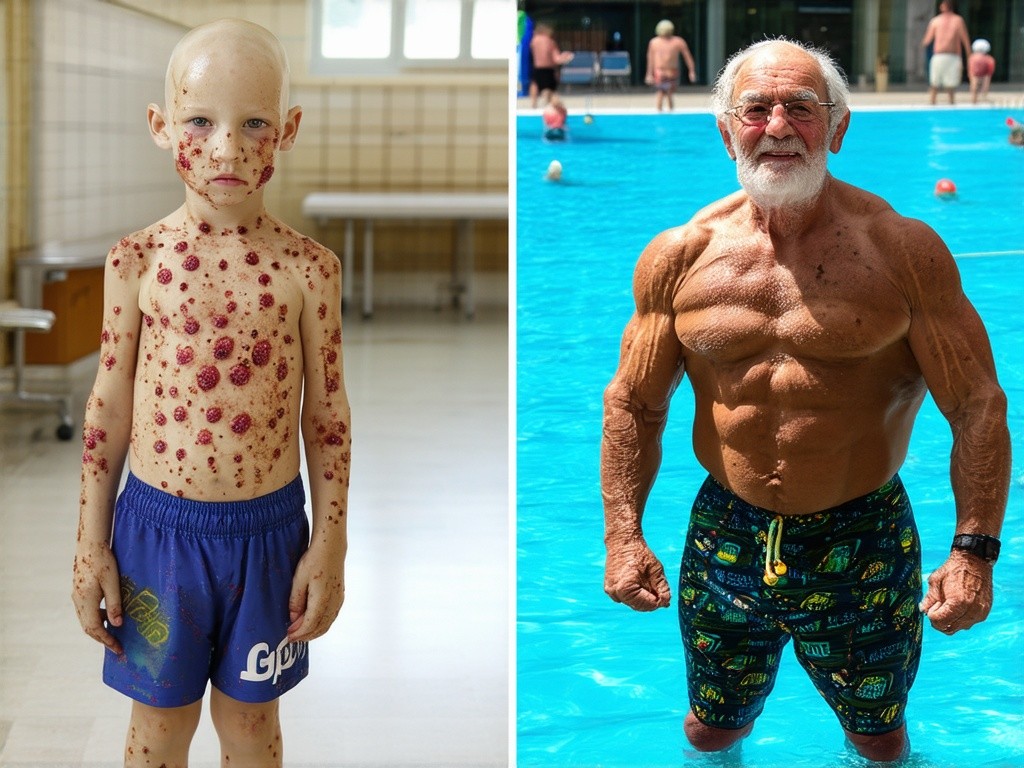
My skin’s rebellion drove me to the carnivore diet—and a startling rebirth.
At 13, I loomed over most teachers and even the 19-year-old 6th Form boys, a gangly 6’4” (1.93m) tower of insatiable hunger. My journey from a normal baby to this towering height was fuelled by a relentless appetite—I was the human garbage disposal for everyone’s leftovers. “Don’t let it go to waste, give it to ‘Waste,’” they’d say. Carbs were my filler: bread dominated teatime, supplemented by scraps of fruit, a spoonful of veg, or the sugar-laden desserts no one else wanted. Meat—the good stuff—made up half my plate at every main meal, but it rarely survived the pass-me-down line. Out of nowhere, growing ‘up’ crashed to a halt. I’m still 1.93.
Acne hit me like a volcanic eruption, a biological ambush. Multi-headed pustules exploded across the back of my neck, down to my waist, over my inner chest, armpits, groin, and inner thighs. My face, ironically, was the only teenage cliché—mostly spared. While other hormonal changes chugged along normally, I lived in dread of any girl-becoming-a-woman offering a friendly hug, only to pull back with a hand smeared in muck. Our khaki school uniforms (a variation of which I wore through my first 13 working years in the bush) spared me endless humiliation, but they couldn’t halt my retreat—physical and mental. The guys were different; they never flinched when I stripped after rugby, stuffing my bloodied jersey and shorts into a bag for Mom to tackle. But city work life in my mid-30s was a nightmare—every eruption brewing beneath my white shirt was a ticking bomb of dread.
The treatment odyssey was a medical horror show. “Sun’s the key,” one doctor declared. “Ever seen a Black kid with acne?” He had a point—until the 1980s, when I saw black teens with breakouts as bad as mine had been. Meds were scarce in the ‘60s; beyond hydrogen peroxide, gentian violet, and penicillin, options were a fantasy. “A clean boy is a Life Boy soap boy,” was the mantra. Mom concocted poultices from mashed soap and sugar, binding them hot against my worst spots with strips torn from old vests. We hoarded home remedies like others collected seashells. The “sure-fire cure”—washing with my own urine and drinking a glass before bed—proved useless after a year. Doctors escalated to surgical sagas, from awkward and embarrassing to theatrical and agonizing. I lost count of the “perpetual weepers” carved out of me, but three stand out: three general anaesthetics in three years left me with a fist-sized hole in my armpit, a chunk of flesh above my left nipple excised after a late-night call from a panicked doctor, and a tennis-ball-sized growth delicately removed from beside my spine under local anaesthetic in his office. “Never seen anything like it,” the surgeon mused. It wasn’t cancerous, just bizarre.
Hope flickered with pharmaceuticals. By 39, I’d become Test Subject #1 for drug trials, and my skin improved 70-80%—a triumph! Yet hundreds of blackheads still clogged my pores, and acne scars etched a “pepper-shot shotgun blast” pattern so unsightly that going shirtless remained unthinkable. The pimple meds made my skin sun-sensitive, and decades working in rural Zimbabwe, South Africa, and Malaysia erupted as pre-cancerous spots by 60. My Anglo-Irish German hide—calibrated for European winters, not equatorial summers—lost the battle. I’d been cautious, avoiding midday sun and slathering on top-tier lotions to dodge burns, cultivating what we pale folks naively called a “healthy” tan: nature’s desperate shield. But when discoloured blotches and rough patches bloomed on my forearms, I couldn’t ignore them. The skin specialist’s reaction was unnerving—he bypassed the obvious growths to probe unrelated areas, muttering about lymphatic involvement. “How good are you with pain?” he asked, then the cutting started all over again before I could answer.
I settled into an eight-to-ten-month cycle of freeze-burning and slicing off suspicious spots. Once, I bumped my forearm on his desk; it bruised instantly. By the session’s end, an 8cm blood blister had ballooned. “Senile purpura,” he mumbled. “Old age, crumbling blood vessels, thin skin—nothing to be done.” “Senile” stung as it joined my growing pathology file, alongside another healing cream for the collection.
Over wound dressings, I bonded with Nurse Anita, sister to the owner of my regular market coffee spot. We’d share a table, and she’d stun me with industry gossip: “Twenty-five years ago, I juggled reception, nursing, and cash. Now we need an accounts controller and four nurses. Don’t say ‘aging population’—our patients’ average age is dropping.” Days before Malaysia’s Covid lockdowns, an angry red rash flared on my scalp (hidden by hair), jawline, lip, and the scratchable zones of my shoulder blades—perfect timing for isolation, with a “don’t-go-near-him” vibe.
For two years, we threw everything at it: food elimination, home remedies, a swelling arsenal of pills. My GP—a friend my age with 50 years of practice in KL—consulted colleagues via smartphone. Quitting shaving was my only cosmetic win. But stress, isolation, and skin rebellion raged on. Warts invaded my feet biannually, blackheads advanced, sun damage lingered, and itchy, dry, infected eyes piled on (see Part 2—The Eye Story). Allergies adopted me. Then, during lockdown, a mystery illness—not Covid—flattened me for weeks. I barely ate. Yet as I recovered, I felt surprisingly fit. And curious.
As detailed in “From Cellular Dysfunction/Mitochondrial Mayhem to Metabolic Healing” (title TBD once I master WordPress), I dove into research—hundreds of hours reading, searching, and listening, sidelining peer pressure and media noise for real health insights. On September 1, 2022, I reclaimed my heritage: I went carnivore.
The results were jaw-dropping. Within weeks, my issues began melting away. Cuts—from thorns, handcraft wire, and gym mishaps—healed faster and cleaner. My hip replacement offered proof: the surgeon marvelled at my recovery speed, and a nurse let slip, “I’ve never seen him make such a neat cut!” Acne, sun damage, rashes, warts, bruising, and easy cuts—they weren’t separate plagues but symptoms of cellular chaos. Patterns crystallized: carbs had fuelled the acne into my 30s, worsened by weekly Kweichow and deep-fried buns at Anita’s coffee shop. The “Blacks don’t get acne” line? A myth—by the late ‘70s and ‘80s, their teens were as afflicted as mine. Sun damage? Midday exposure plus crippled cellular repair. The Sunscreen Paradox gnawed at me—research hints chemical sunscreens disrupt melanin and vitamin D, possibly hiking cancer risk by lulling us into false security. Warts, rashes, that illness? Immune dysfunction in a battered system.
Mitochondria—our cellular power plants—crave proper fuel. Quality energy sparks better repair; repair builds resilience; resilience curbs inflammation; less inflammation means a thriving life. My fix? Eat more meat.







 Douglas Schorr
Leave a comment