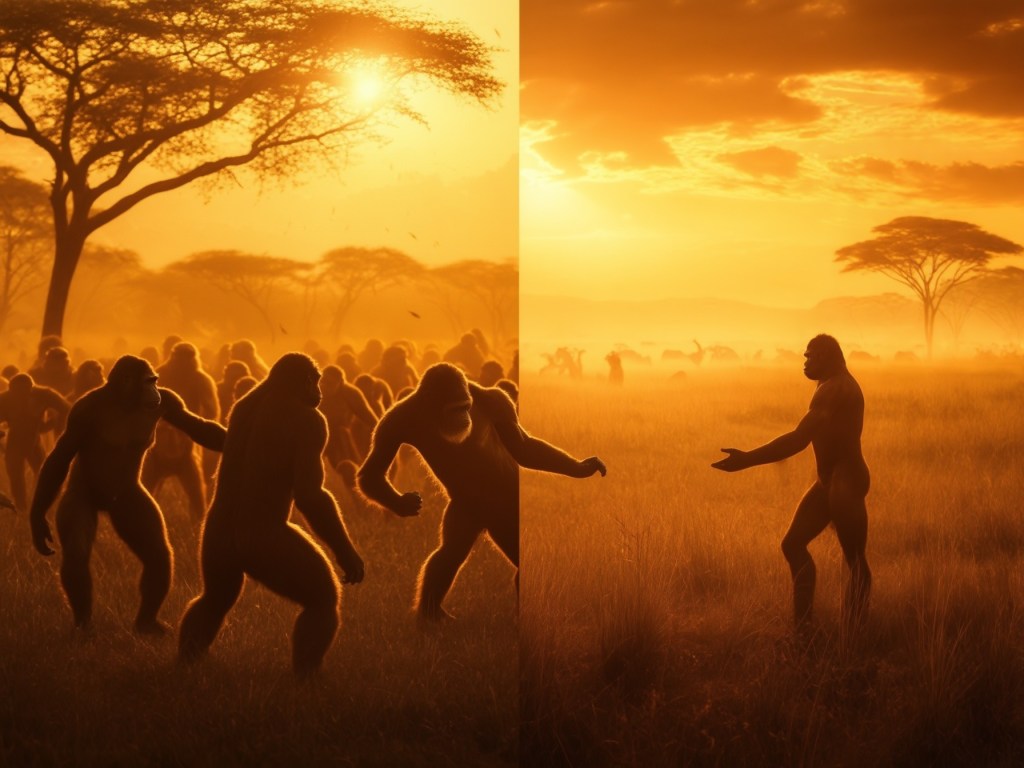
A few million years ago, when our ancestors were still more ape than human, tiny groups wandered the animal-made paths of darkest Africa. To encounter another group was terrifying – triggering pure fight-or-flight response, just as when wild dog packs clash over territory or chimpanzee troops collide in the forest. But we were different. Where other animals expected such meetings, we didn’t. When it happened, terror struck deeper.
With no escape route, we fought – to annihilation. Survival was Rule Number One and there was only one rule. The stronger group simply eliminated the “Them” because they weren’t “Us.” This was raw survival arithmetic, nothing more.
Until one day, when two elders watched their group winning such a clash.
“Oh goodie – we’re winning. We won’t get butchered as per usual,” grunted Grandma.
“Damn the usual,” ooked Granddad, “I spy amongst that group a nubile female and we’re dreadfully short of breeding stock.”
“Funny you mention that,” ooked Grandma, “I see youngsters who could be taught to help. Better than leaving them for the hyenas?”
“Look – two children young enough to raise as our own. They’ll never know different.”
“Exactly! Besides being Them, what IS the difference?” roared the old man, showing off his teeth.
And so the group’s “Think Tank” halted the slaughter. They moved forward, inspected their options, made their choices. They kept the useful and killed the dangerous and useless. The elders’ sudden insight that day – born from pure survival needs for breeding and labour – changed everything.
In that blood-soaked moment, when they first saw potential value in keeping “Them” alive rather than following the animal instinct to kill, our ancestors stumbled upon something revolutionary. For the first time, “Them” could become “Us.” A grant of a second chance at life. And it could happen – given that the winners were winners it likely did – that the second chance amounted to a better chance of living longer better.
Conclusion
This wasn’t noble thinking. But it was another amazing example of conscious evolution. Sure, it was raw survival calculus by beings still more animal than human. But that brain wave – that flash of seeing use instead of threat in the “other” – marked another giant step for mankind. As primitive as our species was it was an advance for our imagination, a great lurching step toward expanding the tribal circle.
That we later perverted this innovation into the systematized exploitation we experience in modern times shows how far we still are from true humanity. But on that ancient day, when the instinct of hundreds of millions of years of breeding yielded to conscious opportunity – the recognition and implementation of a new “what if” – we advanced the long crawl out of pure animality.
Postscript Challenge
Can you think of even one human advancement-innovation which we haven’t turned upside down into a perversion? It is not about whether our ancestors were right or wrong by today’s standards. You’ve been gifted a massively superior intellect by successive grandparents going all the way back to those who made the decisions of this post. Look about yourself – with Materialism and Envy Incorporated America leading the way we’re on the verge not of saving some of Them but of wiping out all of US. What opportunities are you taking to expand the circle of “Us”?
END … I hope not. I believe in people.




 Douglas Schorr
Leave a comment