
In the beginning
We needed gods. Not because we were weak, but because we were becoming strong in a new way. We were learning to ask questions, and we needed someone to ask.
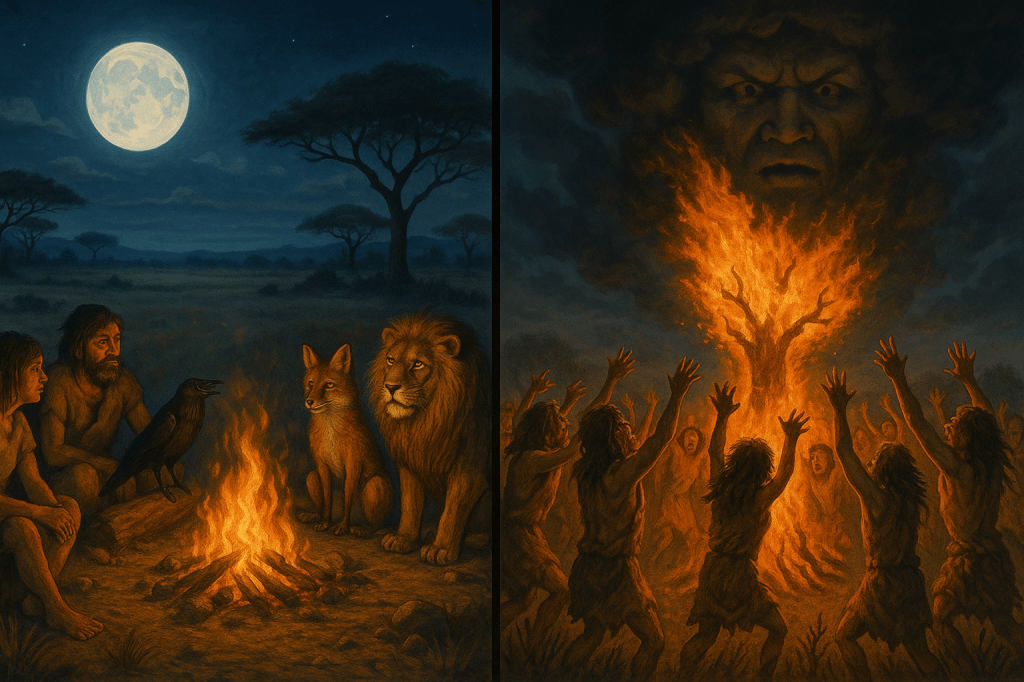
Picture a massive tree atop a hill, its bark scarred black by lightning strikes, yet its leaves still dancing in the wind. This was more than just a tree – it was the first bridge between earth and sky, between what our ancestors could see and what they could imagine. While other animals fled from storms, our ancestors gathered beneath it, their eyes wide with wonder. Here, they asked their first questions of their Supreme Adult, the one who had lived forever, who surely knew why the sky-fire struck and why some survived while others died. It could be asked, “what is going on?”
When our ancestors made their great leap from the trees, they did something no other living thing on earth had done – they chose far more than a lifestyle change as whales had done by returning to the sea. For reasons we’ll never know, they opted for a brand-new existence over a continued comfortable time as ape specialists. This wasn’t just a physical journey from branch to ground; it was the first step toward becoming creatures – the only ones – who could wonder “why?”
These early days were marked by fear and desperate survival. Our ancestors were poorly equipped – no claws, no fangs, small, under-powered. They still had to learn to walk properly never mind run! They cowered in shadows, watching, learning, sneaking out to scavenge what they could. Yet even in this state of constant fear, something remarkable was happening in their minds. They were moving into the unknown, beyond the instinctive behaviours they, as with all living things, had developed over hundreds of millions of years. Instead of being content with the way they were practicing their 4 Ps -produce and parent, provide and protect, an undefined something was prodding them forward.
Think of it as building a wall, brick by brick, but with invisible hands helping. That first brick was early-man, more ape than human, but containing something unique – a spark of initiative. When they used that spark to tentatively mix the ingredients for a second brick, something extraordinary happened. The trinity – you do remember Father Complicity, Mother Evolution, and Mother Nature – descended like a mist upon the project.
Father Complicity made his introductions, suggesting new neural connections. Mother Evolution experimented with these suggestions, but only if they met Mother Nature’s strict laws of survival. When they worked, that second brick was “made” and carefully placed atop the first. Now our ancestors could make two bricks at once, and the wall began to grow.
The mortar between these bricks was curiosity – the ability to ask questions of the Supreme Adult. But the Supreme Adult’s silence was its greatest gift. Because no answers came thundering through the special tree, our ancestors had to learn something crucial – how to frame questions in ways that could be answered through observation, trial, and error. Each correctly framed question became a tool for understanding, a method of research that would eventually become the foundation of all human knowledge.
That lightning tree became their first classroom, their first temple, their first laboratory all in one. There they learned to read the sky, to predict storms, to understand that tall dead trees attracted the sky-fire more than living ones. Each lesson learned was a brick added to their wall of knowledge.
As their powers of deliberation grew, they made a practical discovery. The journey to the sacred place, while essential for life’s greatest mysteries, was impractical for daily questions. And so began, let’s call it, the Age of Gods – a brilliant innovation where specialised deities were created for specific domains of knowledge. The god of hunting could be consulted before the chase, the goddess of childbirth during labour, the spirit of plants while gathering medicine. Hundreds of these specialised divine experts emerged, each one a focal point for questions about their domain.
Now, over the millions of years of our development, multiple walls of knowledge rose within the greater wall of human consciousness. Each specialised area – hunting, healing, cooking, weather-reading, snake and scorpion avoidance – developed its own structure of understanding. The more our ancestors questioned these specialised gods, the more the trinity responded with enhanced cognitive abilities. And the more their minds expanded, the more sophisticated and specific their questions became, creating a magnificent spiral of growing consciousness.
The higher these walls grew, the more we realised how much we didn’t know. Each answer unveiled, like ten, new questions. Think of exploring not just a cave, but the entirety of existence with a torch. The brighter the light, the more we could see of what remained unknown. Our world was bathed in physical light – the sun, the moon, the stars – but our minds were still struggling to illuminate the endless mysteries of existence. We stood at the entrance to understanding, like children at the threshold of a vast labyrinth.
And so we made our pact with the gods – we would continue to praise them and ask our questions, acknowledging the vast unknown, while claiming as our own what we had mastered through our efforts. This bargain recognised both our growing capability and our eternal ignorance. When we learned how to make fire, we didn’t stop praising the fire gods – we thanked them for showing us the way while asking about the deeper mysteries of heat and light. It was a partnership of mutual respect: the gods would guide us toward understanding, and we would honour them by never stopping our quest to learn more.
Recently – if a date is required let’s guess at 50,000 years ago, in Eurasia – this knowledge-building took a dramatic turn. People began specialising beyond the basic male-female divisions of labour. The master hunter, whose word was law in the dangerous bush, needed reminding of social protocols within the community compound. The keeper of the hearth, expert in child-rearing and increasingly so in matters of food preparation and preservation, lost touch with the ways of the wild. This specialisation accelerated learning but, there is always a cost. It also fragmented our once-holistic understanding of our little world.
The price of progress was paid in the currency of unity. What began as a natural division of skills would eventually cleave society into hierarchies of knowledge-keepers and knowledge-seekers.
This was both the golden age and the beginning of a profound transformation in the human-divine partnership. Each question prompted discovery – both an answer and a prayer. When they learned how to track animals by their footprints, they thanked the hunting god for the knowledge while asking about the animals which practised ambush-the-hunter techniques. When they discovered which plants could heal, they praised the forest goddess while begging to understand the sicknesses they couldn’t cure.
The Teaching Tree became the model for all sacred places – spots where learning and worship merged into one act. Ancient Annie, performing a coming-of-age ceremony for a young girl, wasn’t just conducting a ritual; she was teaching the next generation through gestures, grunts, and mime-stories that combined what was known with what was still mysterious. The skull of a mighty elephant that marked a path wasn’t just a way-marker; it was a reminder of what could happen if safe practices were not followed – a lesson in both practical navigation and cosmic significance.
As tribes grew larger, this knowledge-seeking system became more elaborate. It moved ever further from the basics: praise gods for the wonder and mystery, acknowledge we didn’t know the “trick”, define a question, focus discovery efforts, ascertain a “for now” answer, give thanks in the form of disseminating the knowledge. In time, that instruction would be internalised to become part of our innate and cultural heritage. But now, different groups developed specialised relationships with different aspects of the divine. Some became experts at reading weather signs, others at healing, others at handling the delicate politics between families. Each group had their own gods, their own questions, their own growing body of knowledge. But unlike the earlier specialisation that had enriched the whole tribe, this new division began to create walls between people, not just between kinds of knowledge.
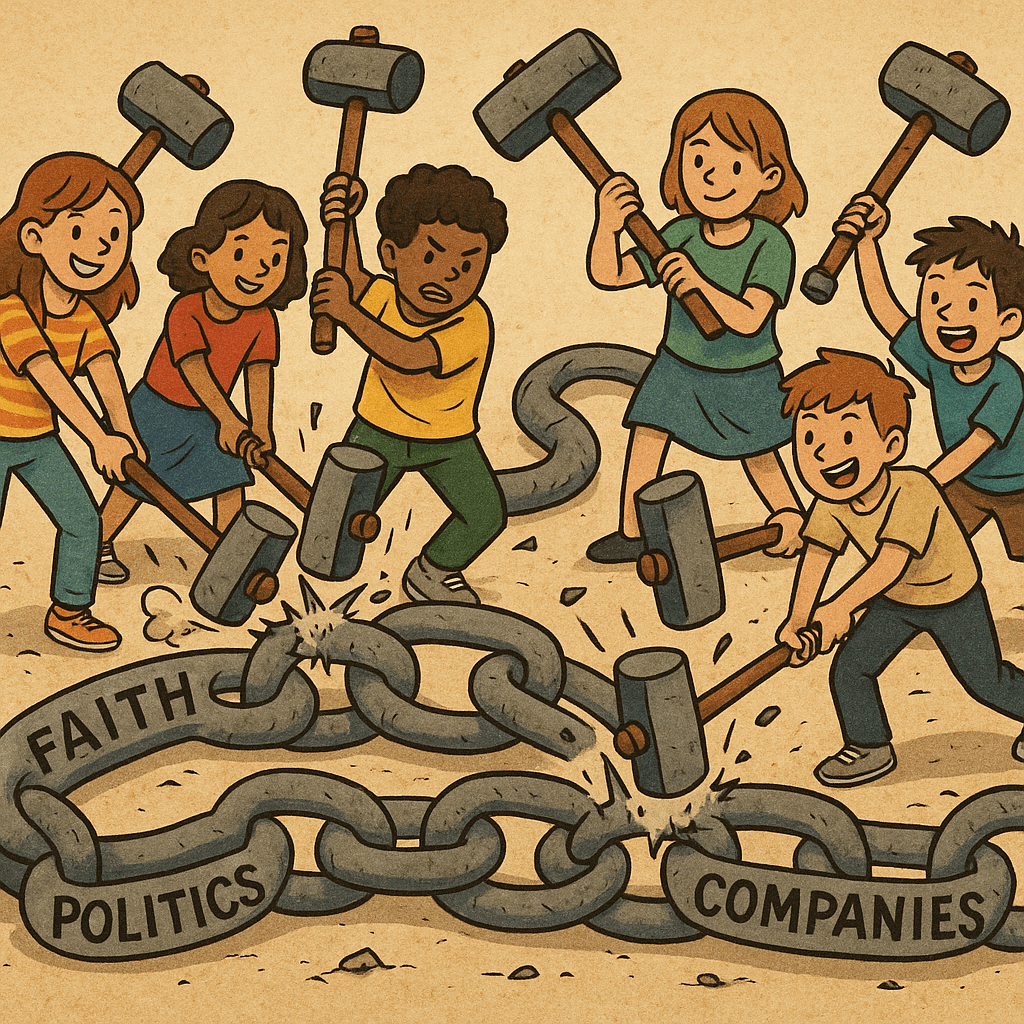
What began as walls of knowledge became walls of separation, and finally, walls of power.
The Great Corruption was underway. “Our god is better (more important) than their god” became the cry, turning the disease of “Us and Them” into a full-blown plague. The same minds that had once reached for understanding now reached for power. The questions became less important than who had the right to ask them. The answers became less important than who had the authority to give them.
Conclusion
This wasn’t a sudden change – it happened slowly, like rot imploding a mighty Baobab tree. The gods didn’t abandon us; we abandoned the true purpose of having them. We stopped using them as bridges to understanding and started using them as walls to keep our own locked in and others out. The masses were distanced from the ancient pact – to praise, to question, to learn, and to share, though – thanks be to the gods – never forgotten by all. The once involved hordes, lamb-like, agreed to follow without amendment to the doctrine of “This is the way of our Lord God.” And when the elites explained, “it is simple, folks. We’ve written it up to avoid all the nonsense of change,” the hordes cheered and gave thanks.




 Douglas Schorr
Leave a comment